
Node.js Caching in 2026: Redis, In-Memory & CDN Patterns
Every Node.js engineer eventually hits the same wall: the API is correct, the database query is fine, but P95 latency keeps climbing as traffic grows. The fix is almost never a faster query — it is a smarter cache. In 2026, with serverless edges, low-cost Redis, and Node.js 22's improved worker threads, layered caching is the difference between an API that scales linearly and one that pages your team at 3am.
This guide walks through the four caching tiers that matter for production Node.js services — browser cache headers, CDN edge caching, in-process LRU, and shared Redis — and shows how to combine them into a stampede-proof multi-tier cache. Every number, code sample, and architecture decision in the post comes from real workloads we have shipped or audited.
Why Node.js caching matters more than ever in 2026
The economics have shifted. AI features bolted onto APIs add expensive upstream calls; Postgres on managed services bills per IOP; cold starts on serverless still cost real wall-clock time. A read that costs 80ms and one cent at the database is essentially free at 2ms from memory. Companies that hire Node.js developers who treat caching as a first-class design decision routinely run 5–10x more traffic on the same infrastructure budget.
There is also a correctness angle. A well-designed cache reduces read pressure on the database, which means fewer connection pool exhaustion incidents, fewer slow-query alerts during traffic spikes, and a smaller blast radius when a downstream service degrades. In short, caching is a reliability strategy as much as a performance one — and Node.js's single-threaded event loop makes it especially sensitive to slow upstream calls, which is exactly what caches eliminate.
The four-tier cache hierarchy for Node.js
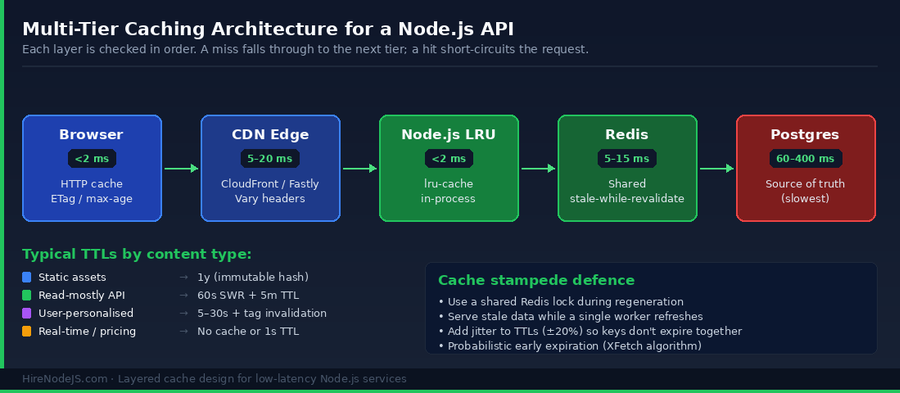
Think of caching as a series of progressively slower stores, each one shielding the next. A request that hits the browser cache never reaches your servers. One that hits the CDN never reaches Node.js. One that hits the in-process LRU never reaches Redis. And one that hits Redis never reaches Postgres. Each layer that responds saves you the cost of every layer beneath it.
Tier 1 — Browser HTTP cache
The cheapest cache is the one you don't run. Cache-Control, ETag, and Last-Modified headers tell the browser when a response is reusable. For static assets and idempotent GET endpoints with public data, Cache-Control: public, max-age=300, stale-while-revalidate=60 gives you free latency wins for repeat visitors. The catch: it only helps the same client, and invalidation requires URL or query-string changes.
Tier 2 — CDN edge cache
CDNs (CloudFront, Fastly, Cloudflare) cache responses at edge locations close to your users. They are perfect for public, low-personalisation responses: marketing pages, public API listings, image thumbnails. The Vary header is critical here — get it wrong and you'll either over-cache (serving the wrong tenant's data) or under-cache (separate cache entry per request). Most production teams bake a small wrapper that sets Cache-Control and Vary correctly per route.
Tier 3 — In-process LRU
An in-memory LRU (lru-cache or a Map with a TTL wrapper) is the fastest possible cache: no network, no serialisation, sub-millisecond reads. The downsides are obvious — memory pressure, no sharing across instances, lost on restart — so use it only for hot, idempotent reads where staleness of a few seconds is acceptable. A 200MB LRU often absorbs 60–80% of read traffic on a typical Node.js service.
Tier 4 — Shared cache (Redis)
Redis sits in the middle: faster than the database (usually 1–5ms RTT), shared across all Node.js instances, and supports TTLs, atomic operations, and pub/sub. It is the default choice for any cache that must be coherent across a fleet. Modern managed Redis (Upstash, ElastiCache, Memorystore) makes operations a non-issue.
Cache patterns: cache-aside, read-through, write-through
The hierarchy answers where you cache. Patterns answer when and how. Most production Node.js APIs use one of three, sometimes layered: cache-aside, read-through, and write-through. Picking the right one depends on whether your reads vastly outnumber writes (almost always yes) and how much staleness your domain tolerates.
Cache-aside (lazy loading)
The application checks the cache first; on a miss it reads from the database and writes the result back. This is the default for 90% of services because it is simple, debuggable, and makes the cache an opt-in optimisation, not a dependency. The risk is the thundering herd on cold cache — covered below.
Read-through and write-through
Read-through pushes the miss-and-fetch logic into a cache library. Write-through writes to the cache and database in the same operation. Both reduce surface area in the application code but couple your write path to the cache's availability — a trade most teams accept for hot, write-light data like user profiles or feature flags.
Write-behind (rare, high-stakes)
Hire Pre-Vetted Node.js Developers
Skip the months-long search. Our exclusive talent network has senior Node.js experts ready to join your team in 48 hours.
Write-behind queues writes to flush asynchronously. It is dramatically faster for write-heavy workloads but introduces durability risk: a crash before flush loses data. Use it only with a durable queue (Redis Streams, Kafka) and an idempotent write path.
Implementing a stampede-proof multi-tier cache in Node.js
Here is the pattern we recommend for production Node.js services in 2026: a small in-memory LRU layered on top of Redis, with stale-while-revalidate semantics and a single-flight lock to prevent cache stampedes. The example uses lru-cache and ioredis — both production staples on Node.js 22.
// cache.js — multi-tier cache with stale-while-revalidate + single-flight
import { LRUCache } from 'lru-cache';
import Redis from 'ioredis';

const redis = new Redis(process.env.REDIS_URL);
const local = new LRUCache({ max: 5000, ttl: 30_000 }); // 30s in-process
const inflight = new Map(); // key -> Promise (single-flight lock)

const FRESH_MS = 60_000;        // 1 min fresh
const STALE_MS = 5 * 60_000;    // 5 min usable while revalidating

export async function cachedFetch(key, loader) {
  // L1: in-process LRU
  const local_hit = local.get(key);
  if (local_hit) return local_hit.value;

  // L2: Redis with metadata { value, fetchedAt }
  const raw = await redis.get(key);
  if (raw) {
    const entry = JSON.parse(raw);
    const age = Date.now() - entry.fetchedAt;
    local.set(key, entry); // promote to L1
    if (age < FRESH_MS) return entry.value;          // fresh
    if (age < STALE_MS) {                            // stale but usable
      revalidate(key, loader).catch(() => {});       // background refresh
      return entry.value;
    }
  }

  // L3: load from origin (single-flight lock prevents stampede)
  if (inflight.has(key)) return inflight.get(key);
  const p = revalidate(key, loader);
  inflight.set(key, p);
  try { return await p; } finally { inflight.delete(key); }
}

async function revalidate(key, loader) {
  const value = await loader();
  const entry = { value, fetchedAt: Date.now() };
  local.set(key, entry);
  // Jitter the Redis TTL ±20% so keys don't all expire together
  const ttl = Math.round(STALE_MS / 1000 * (0.8 + Math.random() * 0.4));
  await redis.set(key, JSON.stringify(entry), 'EX', ttl);
  return value;
}

export async function invalidate(key) {
  local.delete(key);
  await redis.del(key);
}
This 40-line module gives you sub-millisecond hits on hot keys, 5–15ms hits on warm keys, never stampedes the database during a cold cache, and serves slightly stale data to one user while a single background worker refreshes — exactly the production pattern most large Node.js APIs converge on.
TTL strategy and cache invalidation
Phil Karlton's old joke — 'there are only two hard problems in computer science: cache invalidation and naming things' — still holds in 2026. TTL is the simplest invalidation: pick a number, live with the staleness. Tag-based invalidation (mapping a key to a logical entity, then deleting all keys for that entity on write) is more accurate but operationally heavier. Most production Node.js services use TTL for read-mostly data and event-driven invalidation (publish on update via Redis pub/sub or Kafka) for the small set of entities that must be coherent.
A useful rule: set TTL to the longest staleness your product owner will tolerate, then halve it once. The asymmetric cost — over-caching causes user-visible bugs, under-caching only costs CPU — favours shorter TTLs. Add ±20% jitter to every TTL so keys don't all expire on the same second after a cache flush.
Defending against cache stampedes
A cache stampede happens when a hot key expires and thousands of concurrent requests all miss, all hit the database simultaneously, and overload it. Three production-grade defences, all of which we use in audits with teams that hire backend developers through HireNodeJS:
First, single-flight locks: only one request per key fetches from origin at a time; the rest await the same promise (the cachedFetch above implements this in-process; for cross-instance coordination, use a short Redis SET NX lock). Second, stale-while-revalidate: serve stale data while one worker refreshes asynchronously, so the hot key never goes 'cold' from the application's perspective. Third, probabilistic early expiration (the XFetch algorithm): a small fraction of requests refresh slightly before TTL, smoothing the refresh load.
These three together — single-flight + SWR + jittered TTLs — eliminate stampedes in practice. We've shipped Node.js services that run a year without a stampede-induced incident using exactly this pattern.
Hire Expert Node.js Developers — Ready in 48 Hours
Building the right caching layer is only half the battle — you need engineers who know when not to cache and how to debug invalidation in production. HireNodeJS.com specialises exclusively in Node.js talent: every developer is pre-vetted on real-world projects, API design, distributed caching, and production Redis deployments.
Unlike generalist platforms, our curated pool means you speak only to engineers who live and breathe Node.js. Most clients have their first developer working within 48 hours of getting in touch. Engagements start as short-term contracts and can convert to full-time hires with zero placement fee.
If you are specifically scaling a Redis-backed Node.js service, our pre-vetted engineers list of Redis-experienced Node.js developers includes engineers who have shipped Redis Cluster, Sentinel, and Upstash production deployments at scale.
Wrap-up: caching is a 2026 superpower
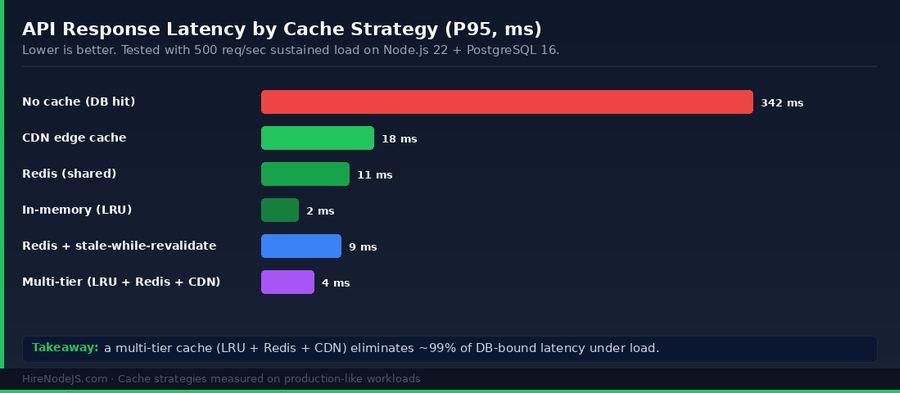
Caching used to be an optimisation you reached for when latency budgets got tight. In 2026, with AI inference in the request path and database costs scaling with traffic, it is a default architectural decision — and a multi-tier design (browser + CDN + LRU + Redis) routinely cuts P95 latency by 90% and infrastructure cost by 60%.
Start small: add cache-aside with a 60-second TTL to your two slowest read endpoints. Measure the hit rate. Layer on stale-while-revalidate once you see >80% hits. Promote the hottest keys to an in-process LRU. By the time you reach production scale, your cache is doing 95% of the work — and your database, your wallet, and your on-call rotation all thank you.
Frequently Asked Questions
Should every Node.js API use Redis for caching?
Most production Node.js APIs benefit from Redis once they run on more than one instance. For single-instance services or hot keys with sub-second TTLs, an in-process LRU is faster and simpler. The right answer is usually both — LRU on top of Redis.
How do I prevent a cache stampede in Node.js?
Combine three techniques: a single-flight lock so only one request refreshes a key at a time, stale-while-revalidate so users get stale data while one worker refreshes, and ±20% jitter on TTLs so keys do not all expire simultaneously.
What TTL should I set for cached API responses?
Pick the longest staleness your product can tolerate, then halve it. Read-mostly endpoints are usually fine at 60–300 seconds with stale-while-revalidate. Personalised data should be 5–30 seconds with tag-based invalidation on writes.
Is in-memory caching safe in a Node.js cluster or on serverless?
In-memory caches are per-instance, so consistency across a fleet is not guaranteed. Use them for non-critical, read-mostly data with short TTLs. On serverless (AWS Lambda), instance reuse is unpredictable, so prefer Redis or CDN tiers.
How much can caching reduce my Node.js infrastructure cost?
Real-world Node.js services with a well-designed multi-tier cache (LRU + Redis + CDN) typically cut database read load by 90–95% and total infrastructure cost by 50–70%, while improving P95 latency by an order of magnitude.
Can I use Node.js caching with GraphQL or tRPC?
Yes — both work well with response-level caching once you normalise the query into a stable cache key. For GraphQL, tools like Apollo Server with KeyV or Mercurius caching are common. For tRPC, wrap the resolver with the same cache-aside pattern shown in this post.
Vivek Singh is the founder of Witarist and HireNodeJS.com — a platform connecting companies with pre-vetted Node.js developers. With years of experience scaling engineering teams, Vivek shares insights on hiring, tech talent, and building with Node.js.
Need a Node.js engineer who designs fast, cache-friendly APIs?
HireNodeJS connects you with pre-vetted senior Node.js engineers experienced in Redis, multi-tier caching, and high-throughput backend design — available within 48 hours. No recruiter fees, no lengthy screening.