Node.js gRPC: Build High-Performance APIs in 2026
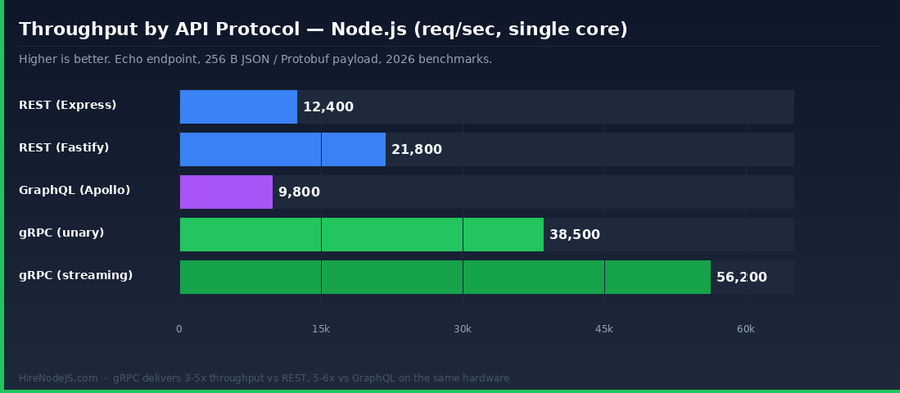
Most Node.js teams default to REST or GraphQL because that is what the wider ecosystem uses. Both are excellent choices for browser-facing APIs — but for east-west traffic between services, neither comes close to gRPC. With HTTP/2 multiplexing, schema-first design, native streaming, and Protobuf wire format, gRPC routinely delivers three-to-five times the throughput at a fraction of the CPU and bandwidth cost.
In 2026, the question isn't whether gRPC is fast — it's whether your team has the patterns and tooling to ship it cleanly. This guide walks through the architecture, real benchmarks, code you can paste into a service today, and the operational lessons we keep seeing when HireNodeJS places engineers on gRPC-heavy stacks.
What gRPC Is, and Why It Wins on the Wire
gRPC is an open-source RPC framework that uses Protocol Buffers for serialisation and HTTP/2 for transport. You define your service contracts in a .proto file, run a code generator, and get strongly-typed client and server stubs in 11+ languages including Node.js. There is no manual JSON parsing, no ad-hoc URL design, no question about whether the field is a string or a number.
The four call patterns
Unlike REST, gRPC supports four call patterns out of the box: unary (request/response, like a normal function call), server streaming (one request, many responses), client streaming (many requests, one response), and bidirectional streaming (both sides talk over the same long-lived connection). The streaming patterns are why gRPC owns real-time pipelines — log shipping, market data, telemetry, AI token streams — without the framing complexity of raw WebSockets.
Wire-level efficiency
Protobuf encodes integers in 1–10 bytes (varint), strings without quoting overhead, and field names as single-byte tags rather than full keys. The result is typically 3–10x smaller than equivalent JSON. Combine that with HTTP/2 header compression (HPACK) and connection multiplexing, and a single TCP connection can carry hundreds of concurrent gRPC calls without head-of-line blocking — exactly the bottleneck that kills REST-over-HTTP/1.1 inside a microservices mesh.
Reference Architecture for a gRPC-First Node.js Stack
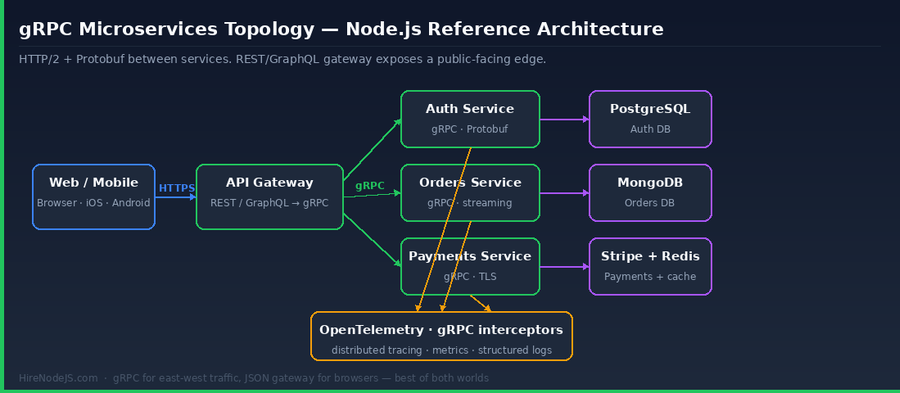
The pattern that holds up in production is a thin REST or GraphQL gateway facing the public internet, with all internal service-to-service traffic running over gRPC. Browsers cannot speak raw gRPC (they need gRPC-Web or a gateway), so trying to expose gRPC directly to a SPA is a common early mistake. Keep the protocol where it earns its keep: between services.
When to reach for gRPC
Use gRPC for synchronous service-to-service calls, low-latency control planes, telemetry pipelines, AI inference hops, and anywhere you previously considered building a custom binary protocol. Stick with REST or GraphQL at the public edge, and use Kafka or NATS for asynchronous fan-out events. Mixing protocols intentionally — rather than picking one for everything — is the mark of a senior backend engineer.
Telemetry without surprises
gRPC plays nicely with OpenTelemetry through interceptors, which behave like Express middleware but for RPC calls. A single interceptor can attach a trace context, time the call, log structured fields, and emit Prometheus metrics — without touching the business handlers. This is one of the operational reasons mature teams pick gRPC: observability is uniform across every service.
Building Your First gRPC Service in Node.js
There are two production-ready Node.js gRPC stacks: the original @grpc/grpc-js (pure JavaScript, recommended) and the older grpc native binding (deprecated). Modern services use @grpc/grpc-js plus @grpc/proto-loader for runtime .proto loading, or generate static TypeScript stubs with ts-proto for the strictest type safety.
The .proto contract
Everything starts with a .proto file. It defines the service surface, the messages, and the field types. Once written and version-controlled, the same file generates the server stubs, the client stubs, mock clients for tests, and even API documentation.
syntax = "proto3";

package orders.v1;

service OrderService {
  rpc GetOrder       (GetOrderRequest)    returns (Order);
  rpc CreateOrder    (CreateOrderRequest) returns (Order);
  rpc StreamOrders   (StreamOrdersRequest) returns (stream Order);
}

message GetOrderRequest    { string id = 1; }
message CreateOrderRequest { string user_id = 1; repeated LineItem items = 2; }
message StreamOrdersRequest{ string user_id = 1; int32 since_unix = 2; }

message LineItem { string sku = 1; int32 qty = 2; int64 price_cents = 3; }

message Order {
  string id            = 1;
  string user_id       = 2;
  repeated LineItem items = 3;
  string status        = 4;
  int64  created_at    = 5;
}
A working server in 30 lines
Here is a minimal but production-shaped Node.js gRPC server using @grpc/grpc-js. It loads the contract at runtime, wires three handlers, and exposes a server-streaming endpoint that pushes new orders as they arrive. In a real service you would inject a database client and wrap the handlers with auth and tracing interceptors.
// server.js
import { Server, ServerCredentials, status as GRPC_STATUS } from '@grpc/grpc-js';
import { loadPackageDefinition } from '@grpc/grpc-js';
import protoLoader from '@grpc/proto-loader';
import { EventEmitter } from 'node:events';

const def = protoLoader.loadSync('./orders.proto', { keepCase: true, longs: String });
const proto = loadPackageDefinition(def).orders.v1;

const orders = new Map();
const events = new EventEmitter();

const handlers = {
  GetOrder(call, cb) {
    const o = orders.get(call.request.id);
    if (!o) return cb({ code: GRPC_STATUS.NOT_FOUND, message: 'order not found' });
    cb(null, o);
  },

  CreateOrder(call, cb) {
    const o = {
      id: crypto.randomUUID(),
      user_id: call.request.user_id,
      items: call.request.items,
      status: 'PENDING',
      created_at: Date.now()
    };
    orders.set(o.id, o);
    events.emit('order', o);
    cb(null, o);
  },

  // Server-streaming: push new orders for this user as they happen
  StreamOrders(call) {
    const onOrder = (o) => { if (o.user_id === call.request.user_id) call.write(o); };
    events.on('order', onOrder);
    call.on('cancelled', () => events.off('order', onOrder));
  }
};

const server = new Server();
server.addService(proto.OrderService.service, handlers);
server.bindAsync('0.0.0.0:50051', ServerCredentials.createInsecure(), (err, port) => {
  if (err) throw err;
  console.log(`OrderService listening on :${port}`);
});Streaming Patterns That Replace WebSockets and Polling
If you are building chat, live dashboards, AI token streams, or real-time inventory, gRPC streaming is usually a better choice than rolling your own WebSocket protocol. You get backpressure, cancellation, deadlines, and structured types for free. Most teams that previously had a Socket.IO server, a queue worker, and a separate REST API end up consolidating onto a single gRPC service after the first quarter on it.
Server-streaming for live updates
Hire Pre-Vetted Node.js Developers
Skip the months-long search. Our exclusive talent network has senior Node.js experts ready to join your team in 48 hours.
The StreamOrders handler shown above is a complete server-streaming endpoint. The client opens the stream once and receives an Order message every time one is created. There is no polling, no long-poll timeout dance, and the protocol handles the disconnect cleanup for you. This is ideal for activity feeds, telemetry, and tail-style log streaming.
Bidirectional streaming for agents
For interactive AI agents, multiplayer state sync, or anywhere both sides need to talk, bidi streaming over a single HTTP/2 connection is the cleanest fit. Each side calls write() and reads from the other's stream — no separate request/response correlation. Keep an eye on backpressure: pause writes when the underlying socket signals it, otherwise memory will grow during slow consumers.
Production Concerns: TLS, Auth, Observability
Transport security
Always use TLS in production — even for internal traffic. ServerCredentials.createSsl() and ChannelCredentials.createSsl() take certificate buffers; combine that with mTLS for service-to-service identity and you eliminate an entire class of lateral-movement attacks. In Kubernetes, a service mesh like Linkerd or Istio can do mTLS transparently for any gRPC service without code changes.
Auth via metadata and interceptors
Authentication in gRPC happens through metadata (think HTTP headers). Clients attach a bearer token, and a server interceptor validates it before the handler runs. The same pattern handles tenant isolation, request signing, and feature flags — it's the gRPC equivalent of Express middleware, but with the call object exposed for streaming endpoints.
If you are productionising a gRPC stack and need engineers who have shipped it under load, HireNodeJS backend developers come pre-vetted on @grpc/grpc-js, mTLS, and OpenTelemetry. For DevOps wiring like Linkerd or Istio meshes, the DevOps engineering pool is the better fit.
A Pragmatic Migration Path from REST to gRPC
You almost never want to rewrite a working REST service in one go. The migration that consistently succeeds is incremental: pick one bottleneck endpoint or one new internal service, ship it as gRPC, and let it prove itself. Most teams measure a 30-50% drop in p95 latency on the migrated path within the first month, plus a meaningful reduction in CPU and outbound bandwidth — usually enough to justify the rest of the rollout.
Step 1 — Add gRPC alongside, not instead
Run gRPC on a sibling port (50051 is conventional) while the REST API stays on 3000 or 8080. Both can share the same business logic; only the transport changes. New internal callers move to gRPC, the existing REST consumers keep working untouched, and you avoid the all-or-nothing migration risk.
Step 2 — Codegen the contract
Pick one .proto compilation pipeline and stick to it across all services. ts-proto with --outputServices=grpc-js produces excellent TypeScript types; buf is the modern lint-and-codegen tool that catches breaking changes before merge. Wire both into CI so a backwards-incompatible .proto change fails the build, not production.
Step 3 — Move east-west traffic first
Service-to-service calls give the biggest payoff with the lowest risk: no public clients, no browser compatibility, and the highest call volumes. Once east-west traffic runs on gRPC, the next step is usually a thin gRPC-Web gateway for selected SPA endpoints — but only if browser performance is the bottleneck.
Hire Expert Node.js Developers — Ready in 48 Hours
Building the right system is only half the battle — you need the right engineers to build it. HireNodeJS.com specialises exclusively in Node.js talent: every developer is pre-vetted on real-world projects, gRPC and microservices design, event-driven architecture, and production deployments at scale.
Unlike generalist platforms, our curated pool means you speak only to engineers who live and breathe Node.js. Most clients have their first developer working within 48 hours of getting in touch. Engagements start as short-term contracts and can convert to full-time hires with zero placement fee — useful when you are uncertain about the long-term scope of the gRPC rollout.
Wrapping Up: When gRPC Pays Back the Learning Curve
gRPC is not the right answer for every endpoint. For a single CRUD app with a browser client and modest traffic, REST plus a typed OpenAPI schema is still the path of least resistance. But the moment you have more than two Node.js services calling each other, real-time streams, or latency budgets measured in tens of milliseconds, gRPC starts paying for itself within weeks.
The patterns are stable, the tooling is mature, and the operational story (interceptors for auth and telemetry, mTLS for identity, OpenTelemetry for tracing) is honestly cleaner than the REST equivalent. The teams that win in 2026 are the ones who pick the right protocol for each layer of the stack — JSON at the edge, gRPC inside, events for fan-out — and have engineers who can move fluently between all three.
Frequently Asked Questions
Is gRPC faster than REST in Node.js?
Yes — for the same workload, gRPC typically delivers 3-5x the throughput of REST and 5-6x more than GraphQL because Protobuf is a binary format and HTTP/2 multiplexes calls over a single connection. The biggest gains show up on small payloads and high call rates.
Can I use gRPC directly from a browser?
Not natively — browsers cannot speak HTTP/2 trailers, which gRPC requires. Use gRPC-Web through an Envoy proxy, or expose a thin REST/GraphQL gateway that translates to gRPC behind the scenes. Most teams keep gRPC for service-to-service traffic only.
Which gRPC library should I use in Node.js?
Use @grpc/grpc-js — the official pure-JavaScript implementation, actively maintained by the gRPC team. The older grpc native binding is deprecated. Pair it with @grpc/proto-loader for runtime loading, or ts-proto for fully typed static stubs.
How does gRPC handle authentication?
Through metadata (similar to HTTP headers) plus server interceptors. Clients attach a bearer token to every call, and an interceptor validates it before the handler runs. For service-to-service identity, mTLS combined with metadata works very well.
When should I NOT use gRPC?
Skip gRPC if your only consumers are web browsers, your traffic is mostly fire-and-forget events (use Kafka or NATS instead), or you have a single low-traffic monolith where REST is already shipping. gRPC pays back its complexity once you have multiple services or strict latency budgets.
How long does a typical REST-to-gRPC migration take?
For a team of 3-5 backend engineers, migrating one bottleneck service end-to-end usually takes 2-4 weeks. A full mesh migration across 10+ services typically runs 2-3 quarters when done incrementally — and the throughput and latency gains generally start showing up after the first service ships.
Vivek Singh is the founder of Witarist and HireNodeJS.com — a platform connecting companies with pre-vetted Node.js developers. With years of experience scaling engineering teams, Vivek shares insights on hiring, tech talent, and building with Node.js.
Need Node.js engineers who have shipped gRPC at scale?
HireNodeJS connects you with pre-vetted senior Node.js backend engineers fluent in gRPC, Protobuf, and microservices — available within 48 hours, no recruiter fees, no lengthy screening.