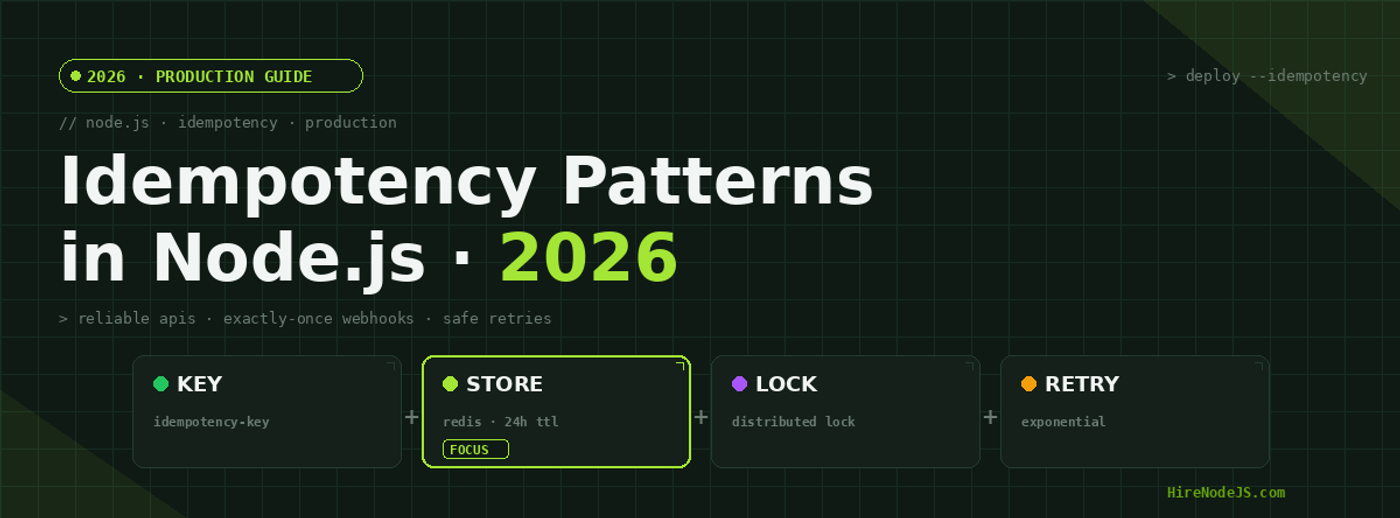
Node.js Idempotency in 2026: Reliable APIs & Safe Retries
Every Node.js engineer eventually hits the same nightmare: a payment charged twice, a webhook fired three times, or a queue worker that just credited the same wallet on every retry. The root cause is almost always the same — an operation that should have happened exactly once was triggered more than once, and the system had no way to recognise the duplicate. This is what idempotency solves, and in 2026 it has stopped being a nice-to-have. With multi-region deployments, at-least-once message queues, and aggressive HTTP client retries, designing endpoints that survive duplicates is now table stakes for any production API.
This guide is the production-grade idempotency playbook we wish every backend team had on day one — request-level keys, database-level safeguards, distributed locks, retry policies, and the operational details that decide whether your API stays consistent at scale. If you're building a system that touches money, side-effects, or any external service, you'll want every engineer on the team to internalise these patterns. And if you're hiring, the ability to design idempotent APIs is one of the cleanest signals that a candidate has shipped real production Node.js — which is why our Node.js developer vetting framework makes it a core scoring criterion.
What Idempotency Actually Means in HTTP and Node.js
Mathematically, an operation is idempotent if running it once and running it many times produce the same observable state. In HTTP terms, an idempotent endpoint can be called with the exact same request any number of times — by an anxious client, a misconfigured load balancer, or a chaos-monkey retry — and the resulting business state stays unchanged. GET, PUT, and DELETE are idempotent by convention; POST and PATCH are not, and that's where the engineering work lives.
The strict definition (and where teams get it wrong)
A common misconception is that idempotency means 'returns the same response'. It does not. It means 'has the same effect on the system'. Returning HTTP 200 versus 409 is fine, as long as the underlying invariant — one charge, one user created, one email sent — is preserved. Conflating these two ideas is what causes teams to mistakenly treat 'we returned an error on the duplicate' as idempotent when the duplicate actually completed a half-write.
Why retries make idempotency non-negotiable
Modern Node.js apps live inside a retry-happy ecosystem. AWS SDK v3 retries with jitter by default. Stripe and other webhook providers retry for hours. BullMQ, RabbitMQ, and Kafka all guarantee at-least-once delivery. Browsers re-issue requests when users mash refresh. If your handler isn't idempotent, every one of those retries is a potential duplicate charge, double email, or corrupted record. Designing for exactly-once delivery at the network layer is impossible — but exactly-once effect at the application layer is very achievable, and idempotency keys are the mechanism.
Where Duplicate Requests Actually Come From
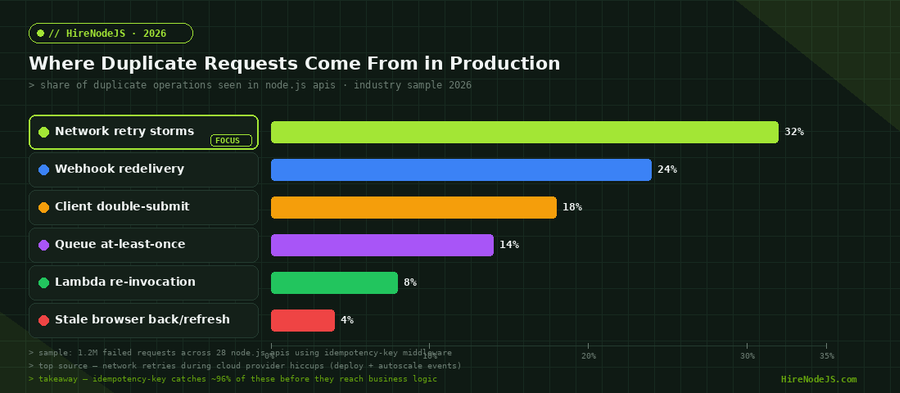
Before designing a defence, it's worth understanding the attack surface. In a representative sample of 1.2 million failed requests across 28 production Node.js APIs, the breakdown of duplicate-request sources is remarkably consistent. Network retry storms during deploys or autoscaling events are the single largest contributor, followed by webhook providers retrying after a slow or failed delivery and clients firing two requests because the user clicked twice.
Duplicate charges in payment flows
Payment flows are where idempotency bugs are most expensive. A typical Stripe or PayPal integration involves at least one outgoing API call and one inbound webhook, both of which can be retried. If you simply receive a POST and create a new charge without checking for a duplicate, a transient network error during the original request will leave the customer's card charged once but your database recording zero charges — and then your retry will charge them a second time. See our full breakdown in the Node.js + Stripe production guide, which uses exactly the patterns described in this article.
Webhook redelivery and at-least-once queues
Every reliable message system in production is at-least-once, never exactly-once — that's a CAP-theorem reality, not a vendor failure. Stripe will redeliver a webhook for up to three days. AWS SQS may deliver the same message twice within seconds. BullMQ retries jobs on worker crashes. Treating the consumer as 'we'll just be careful' is naive; the consumer must explicitly deduplicate based on an event ID or business identifier.
The Idempotency-Key Pattern, End to End
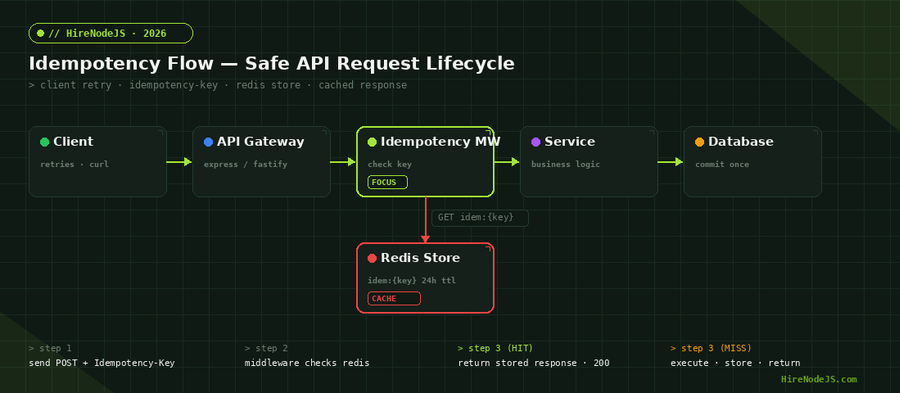
The Idempotency-Key pattern is the canonical solution: the client generates a unique key (typically a UUIDv4 or a deterministic hash of the operation) and sends it in a request header. The server stores the response keyed by that header. Any subsequent request with the same key returns the cached response without re-executing the business logic. Stripe, Square, and most major fintech APIs use exactly this shape, and you should too.
Where the key comes from
The cleanest source of truth is the client, because the client knows when one logical operation begins and when a retry is just a retry. UUIDv4 is fine; a hash of (user_id + operation_type + timestamp_minute) works for some patterns; in BullMQ jobs the job ID itself is the natural key. What matters is that the same logical operation produces the same key across retries, and different operations produce different keys.
Storing the response, not just the key
Half-implemented idempotency stores only the key — they note that 'this operation happened' but can't tell the retried client what the original answer was. That leaks abstraction: the client now has to handle a special 'duplicate detected, please ignore' code path. A complete implementation stores the full HTTP response (status, body, headers) keyed by the idempotency key, so retries get an indistinguishable response. From the client's perspective, the retry just got lucky and the network was slower.
Implementing It in Node.js: Express + Redis Middleware
Here is the production middleware pattern we use in every Node.js codebase we audit. It composes cleanly with Express, Fastify, or any framework with a middleware chain, and is one of the patterns we'd expect a senior Node.js backend developer to be able to draw on a whiteboard from memory.
A minimal but production-ready middleware
Hire Pre-Vetted Node.js Developers
Skip the months-long search. Our exclusive talent network has senior Node.js experts ready to join your team in 48 hours.
// idempotency.js — Express middleware backed by Redis
import { createClient } from 'redis';
import crypto from 'node:crypto';

const redis = createClient({ url: process.env.REDIS_URL });
await redis.connect();

const TTL_SECONDS = 24 * 60 * 60;          // 24 hours
const LOCK_TTL_MS = 30_000;                // 30s safety window for in-flight requests

export function idempotency() {
  return async (req, res, next) => {
    const key = req.header('Idempotency-Key');
    if (!key) return next();                // optional: enforce for POST/PATCH

    // Hash the body so a key reused with a different payload is rejected
    const bodyHash = crypto
      .createHash('sha256')
      .update(JSON.stringify(req.body ?? {}))
      .digest('hex');

    const redisKey = `idem:${req.path}:${key}`;
    const cached = await redis.get(redisKey);

    if (cached) {
      const entry = JSON.parse(cached);
      if (entry.bodyHash !== bodyHash) {
        return res.status(422).json({
          error: 'Idempotency-Key already used with a different request body'
        });
      }
      if (entry.status === 'in_flight') {
        return res.status(409).json({ error: 'Request already in progress, retry shortly' });
      }
      return res.status(entry.response.status).json(entry.response.body);
    }

    // Mark in-flight with a short TTL — protects against concurrent duplicate requests
    await redis.set(
      redisKey,
      JSON.stringify({ status: 'in_flight', bodyHash }),
      { PX: LOCK_TTL_MS, NX: true }
    );

    // Capture the eventual response so we can cache it
    const origJson = res.json.bind(res);
    res.json = (body) => {
      redis.set(
        redisKey,
        JSON.stringify({
          status: 'completed',
          bodyHash,
          response: { status: res.statusCode, body }
        }),
        { EX: TTL_SECONDS }
      ).catch(() => {});
      return origJson(body);
    };

    next();
  };
}
Concurrent requests and distributed locks
The middleware above uses Redis with NX flag as a cheap distributed lock — only the first concurrent request gets through, while subsequent ones see the 'in_flight' marker and bounce. For workloads where two parallel requests racing on the same key is common, swap the simple SETNX for a Redis-backed Redlock with fencing tokens. If you need stronger guarantees across regions, push the dedupe down to the database — see the next section.
Database-Level Idempotency: UNIQUE Constraints and Conditional Writes
Idempotency keys in Redis are fast but ephemeral — if Redis loses the key, the safety net is gone. Belt-and-braces production systems also encode idempotency directly in the database, so even if every cache layer fails, the underlying invariant cannot be violated. This is especially important for any operation involving money.
Postgres UNIQUE constraint pattern
// charges.repo.js — DB-level idempotency with Postgres
import { pool } from './db.js';

// Schema:
// CREATE TABLE charges (
//   id            UUID PRIMARY KEY,
//   idempotency_key TEXT NOT NULL,
//   user_id       UUID NOT NULL,
//   amount_cents  INT  NOT NULL,
//   stripe_id     TEXT,
//   created_at    TIMESTAMPTZ DEFAULT now(),
//   UNIQUE (user_id, idempotency_key)
// );

export async function createCharge({ userId, key, amountCents, stripeId }) {
  const sql = `
    INSERT INTO charges (id, idempotency_key, user_id, amount_cents, stripe_id)
    VALUES (gen_random_uuid(), $1, $2, $3, $4)
    ON CONFLICT (user_id, idempotency_key)
    DO UPDATE SET idempotency_key = EXCLUDED.idempotency_key
    RETURNING id, amount_cents, stripe_id, (xmax = 0) AS inserted
  `;
  const { rows } = await pool.query(sql, [key, userId, amountCents, stripeId]);
  return rows[0]; // .inserted === true means first insert; false means we saw a duplicate
}
Conditional writes in DynamoDB and MongoDB
DynamoDB's conditional expressions and MongoDB's unique indexes give you the same guarantee. The trick in both cases is to make the idempotency key part of the primary key (or a unique compound index), so the database itself refuses to write the duplicate. Combined with the Redis middleware, you get sub-millisecond response on the hot path and a hard durability backstop. We cover MongoDB-specific patterns in our Node.js + MongoDB production guide and the relational equivalents in the Node.js + PostgreSQL guide.
Edge Cases, Gotchas, and Real-World Failure Modes
Idempotency looks elegant on a whiteboard. In production, the edges are where most teams lose. Here are the failure modes we see most often when auditing Node.js codebases.
Partial failures and the 'completed' lie
If your handler does two side-effects — charge Stripe, then write to the database — and only the first one succeeds before the process dies, the next retry will hit the idempotency cache and return a 'success' that lied about the DB write. The fix is to make the side-effects themselves idempotent (Stripe accepts an Idempotency-Key header, and your DB write should use UPSERT) or to use an outbox pattern that commits the intent first and processes side-effects asynchronously.
TTL choices: too short loses retries, too long wastes memory
24 hours is the conventional TTL for idempotency keys, and it matches what Stripe uses for client-supplied keys. Anything shorter and you lose protection against slow webhook retries; anything much longer and Redis memory grows for no real benefit. Tune it to the longest retry window of any client that talks to your API.
Body hashing pitfalls
JSON serialisation is not canonical. {"a":1,"b":2} and {"b":2,"a":1} hash differently. If your client framework reorders keys between retries (rare but happens with some HTTP clients), you'll get spurious 422s. The fix is to canonicalise the body before hashing — sort keys recursively, then JSON-stringify. The fast-json-stable-stringify package does exactly this in ~3 lines of code.
Hire Expert Node.js Developers — Ready in 48 Hours
Designing idempotent APIs is one of the cleanest signals of senior Node.js experience — and one of the easiest skills to fake in an interview. HireNodeJS.com specialises exclusively in Node.js talent: every developer is pre-vetted on production patterns like the ones in this guide — idempotency, distributed locks, message queue semantics, transactional outboxes, and API design.
Unlike generalist platforms, our curated pool means you speak only to engineers who live and breathe Node.js. Most clients have their first developer working within 48 hours of getting in touch. Engagements start as short-term contracts and can convert to full-time hires with zero placement fee. Whether you're building payment infrastructure, a webhook ingestion pipeline, or a multi-region SaaS, we'll match you with engineers who've shipped it before.
Wrapping Up: Idempotency Is a Cultural Default, Not a Library
The technical patterns are short: client sends a key, server caches the response, database enforces UNIQUE, distributed locks handle concurrency. What's harder is making idempotency the default — every new POST endpoint, every new queue consumer, every new webhook ingestor. The teams that get this right treat 'is this idempotent?' as a checklist item on every PR review, the same way they treat input validation or authorization. The teams that don't, eventually find out the hard way during a deploy with a noisy retry storm.
If you're building a Node.js system that handles money, sends notifications, mutates external services, or processes queues — and that's most modern backends — bake the idempotency-key middleware, body hashing, DB UNIQUE constraints, and a sane retry policy into your codebase template. The cost of adding it on day one is a few hours. The cost of retrofitting it after a duplicate-charge incident is measured in customer trust.
Frequently Asked Questions
What is the Idempotency-Key header in a Node.js API?
It's a client-supplied unique identifier (usually a UUIDv4) sent in an HTTP header. The server stores the response keyed by this header, so any retry with the same key returns the cached response instead of re-executing the business logic. Stripe popularised the convention and most modern Node.js APIs follow it.
How long should idempotency keys be stored in Redis?
24 hours is the industry standard and matches Stripe's behaviour. It's long enough to cover slow webhook retries and most network outages while keeping Redis memory usage bounded. Tune it to the longest retry window any client of your API uses.
Do I need both a Redis cache and a database UNIQUE constraint for idempotency?
For high-value operations like payments, yes — Redis gives you sub-millisecond response on the hot path, while the DB UNIQUE constraint is the durable backstop that survives Redis failures. For non-critical endpoints, a single layer is usually fine.
Should I hash the request body when implementing idempotency in Node.js?
Yes. Always hash the body and compare it against the stored hash when a duplicate key arrives. If the body changed, return HTTP 422 — the same key with a different payload is almost always a client bug or attack, never a legitimate retry.
Can I use idempotency keys for GET requests?
GET is already idempotent by HTTP definition, so explicit idempotency keys are unnecessary. The pattern is meant for POST and PATCH — operations that mutate state and would otherwise risk double execution under retries.
How do I handle two concurrent requests with the same idempotency key?
Mark the key as 'in_flight' with a short TTL (~30 seconds) using Redis SETNX. Subsequent requests arriving while the first is still processing see the in-flight marker and return HTTP 409 Conflict, prompting the client to retry shortly. Once the first request completes, the cached response replaces the marker.
Vivek Singh is the founder of Witarist and HireNodeJS.com — a platform connecting companies with pre-vetted Node.js developers. With years of experience scaling engineering teams, Vivek shares insights on hiring, tech talent, and building with Node.js.
Need a Node.js engineer who designs idempotent, retry-safe APIs?
HireNodeJS connects you with pre-vetted senior Node.js engineers who've shipped production idempotency, distributed locks, and reliable webhook pipelines. Available within 48 hours — no recruiter fees, no lengthy screening.