Node.js + Kafka: Event Streaming Architecture Guide (2026)
Event streaming has moved from a niche tool for data engineers to the backbone of modern Node.js backends. In 2026, the services that feel instant — live order tracking, in-app notifications, fraud scoring, AI-powered personalization — are almost all fed by Kafka topics behind the scenes. If your Node.js system still relies on synchronous HTTP calls between services, you are paying for it in tail latency, flaky retries, and painful on-call rotations.
This guide is the playbook I wish more Node.js teams had when they start with Kafka: the architecture you should aim for, which client library to pick, how to get exactly-once semantics right, real TypeScript code you can ship, and the latency and throughput numbers you should expect on commodity hardware. We will also cover the hiring side — what to look for in a Node.js engineer who has actually shipped event-driven systems, and where to find one.
Why Node.js + Kafka Is the Default Event Backbone in 2026
Three shifts pushed Kafka from "big-data tool" to the default event backbone for Node.js teams. First, managed offerings — Confluent Cloud, AWS MSK Serverless, Aiven, Redpanda Cloud — eliminated most of the operational pain. Second, the Node.js client library ecosystem finally matured: kafkajs is stable, Confluent ships an official JavaScript client, and TypeScript support is first-class everywhere. Third, the industry consensus on KRaft (Kafka without ZooKeeper) made self-hosting cheaper for teams that need to own their data plane.
The jobs Kafka does well for Node.js backends
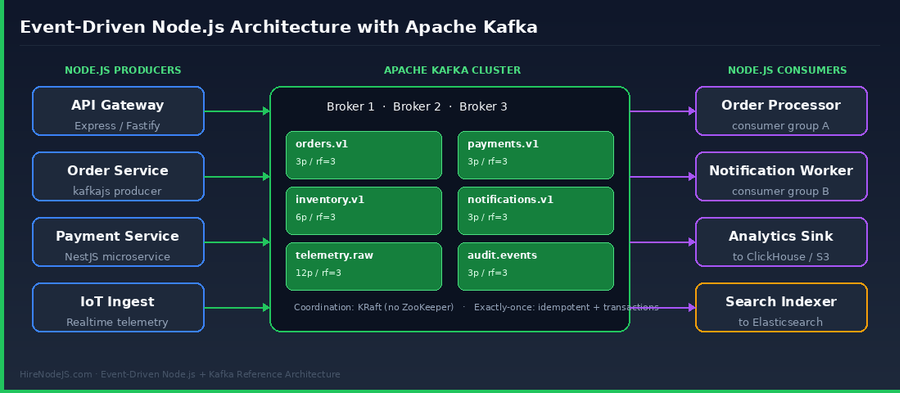
Kafka shines at decoupling producers from consumers while retaining a durable, replayable log. For a Node.js team that means: you can deploy a new consumer that replays the last 30 days of orders to backfill a recommendation index without waking your colleagues on the checkout service. You can split a monolithic order API into a producer and four independent consumers without rewriting a single HTTP endpoint.
When NOT to reach for Kafka
If you need millisecond pub/sub between a few services, Redis Streams or NATS JetStream are lighter. For simple background jobs, BullMQ is still the pragmatic pick — covered in our deep dive on Node.js job queues. Use Kafka when you need durability, replay, high fan-out across consumer groups, or you plan to connect to data systems (ClickHouse, Snowflake, ElasticSearch) via Kafka Connect.
Core Kafka Concepts Every Node.js Developer Must Understand
You cannot build reliable Node.js producers and consumers if you only think in terms of "topics and messages". The durability guarantees, ordering, and scaling behavior all come from a handful of concepts that every Node.js engineer on your team should be able to explain in an interview.
Topics, partitions, and keys
A topic is an append-only log. A topic is split into partitions, and messages with the same key always land on the same partition — which is how Kafka preserves ordering per key, not globally. If you key your "order.created" events by orderId, all events for a given order stay ordered, even as your consumers scale horizontally. Pick your key carefully: a bad key choice (like a country code) creates hot partitions that no amount of consumer scaling can fix.
Consumer groups and offsets
A consumer group is how you horizontally scale reads. Kafka hands out partitions to consumers in the same group so each partition is processed by exactly one consumer at a time. Each consumer keeps an "offset" — the position it has committed up to — and Kafka stores that offset so a restarted consumer picks up exactly where it left off. Committing offsets before you finish processing is one of the most common sources of data loss in Node.js Kafka pipelines.
Replication, ISR, and acks
Production Kafka clusters replicate each partition across brokers. The in-sync replica set (ISR) is the set of replicas caught up with the leader. Your producer's acks setting decides how many ISRs must acknowledge a write: acks=0 is fire-and-forget, acks=1 is the default, acks=all is durable. Match acks to the business risk of losing that particular topic — payments go to acks=all, analytics pings can often live with acks=1.
Choosing a Node.js Kafka Client Library
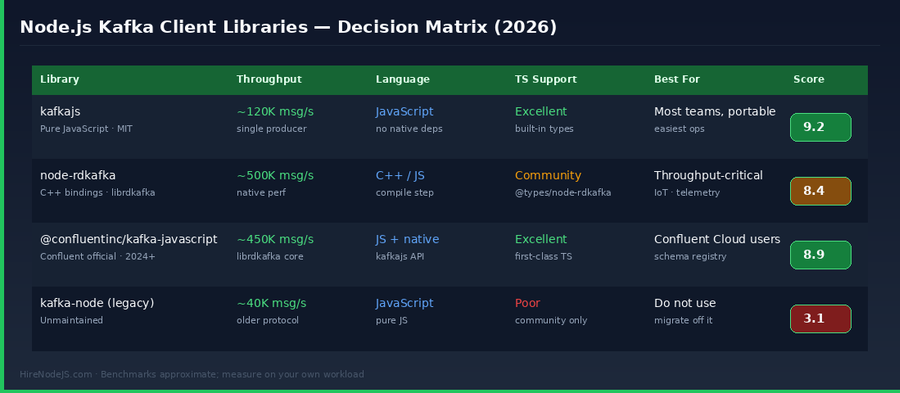
By 2026 there are effectively four libraries a Node.js team will evaluate, and only three are worth shipping. Picking the wrong one is painful — it usually shows up six months later as a performance cliff or a months-long migration.
kafkajs — the default safe choice
kafkajs is pure JavaScript, has zero native dependencies, ships with excellent TypeScript types, and handles the vast majority of workloads just fine — up to a hundred thousand messages per second per producer. If your team is TypeScript-first and you do not have a specialized C++ operator on payroll, start here.
node-rdkafka — when you need raw throughput
node-rdkafka wraps the battle-tested librdkafka C library. It is four to five times faster than kafkajs for producers, supports every Kafka feature the moment it lands in librdkafka, and has configurable exactly-once semantics. The trade-off is a compile step during npm install, platform-specific prebuilt binaries, and a less polished TypeScript story.
@confluentinc/kafka-javascript — the hybrid
Released in 2024, Confluent's official JavaScript client uses the librdkafka core but exposes a kafkajs-compatible API. If you are on Confluent Cloud and want schema registry, kstreams-style processing, and native throughput, this is the strongest pick in 2026.
Building a Production-Grade Producer and Consumer
The example below is the minimum kafkajs setup I would accept in a code review: batched writes, idempotent producers, explicit error handling, graceful shutdown, and manual offset commits on the consumer side. You can paste this into a fresh Node.js project and be pushing events through a local Kafka cluster in minutes.
import { Kafka, CompressionTypes, logLevel } from 'kafkajs';

const kafka = new Kafka({
  clientId: 'order-service',
  brokers: (process.env.KAFKA_BROKERS ?? 'localhost:9092').split(','),
  logLevel: logLevel.INFO,
  ssl: true,
  sasl: {
    mechanism: 'plain',
    username: process.env.KAFKA_USER!,
    password: process.env.KAFKA_PASS!,
  },
  retry: { retries: 8, initialRetryTime: 200 },
});

// Idempotent producer: safe retries, no duplicates per-partition
const producer = kafka.producer({
  idempotent: true,
  maxInFlightRequests: 5,
  allowAutoTopicCreation: false,
});

export async function startProducer() {
  await producer.connect();
  return producer;
}

export async function emitOrderCreated(order: {
  id: string;
  customerId: string;
  amountCents: number;
}) {
  await producer.send({
    topic: 'orders.v1',
    acks: -1, // acks=all — wait for full ISR
    compression: CompressionTypes.ZSTD,
    messages: [
      {
        key: order.id, // preserves per-order ordering
        value: JSON.stringify({ type: 'order.created', ...order }),
        headers: { 'schema-version': '1' },
      },
    ],
  });
}

// Graceful shutdown — critical in Kubernetes
for (const signal of ['SIGINT', 'SIGTERM']) {
  process.once(signal, async () => {
    await producer.disconnect();
    process.exit(0);
  });
}
Consumer with manual commits and retries
Hire Pre-Vetted Node.js Developers
Skip the months-long search. Our exclusive talent network has senior Node.js experts ready to join your team in 48 hours.
The consumer is where most Node.js teams introduce bugs. The #1 mistake is committing the offset before the business work is durable. The snippet below uses manual offset commits and a dead-letter topic for poison-pill messages.
import { Kafka, EachMessagePayload } from 'kafkajs';

const kafka = new Kafka({ clientId: 'order-worker', brokers: ['localhost:9092'] });
const consumer = kafka.consumer({ groupId: 'order-processor-v1', sessionTimeout: 30000 });
const dlq = kafka.producer();

async function processOrder(raw: string) {
  const evt = JSON.parse(raw);
  // idempotent business work keyed on evt.id — safe to retry
  await chargeCustomer(evt);
  await writeLedger(evt);
}

export async function runConsumer() {
  await Promise.all([consumer.connect(), dlq.connect()]);
  await consumer.subscribe({ topic: 'orders.v1', fromBeginning: false });

  await consumer.run({
    autoCommit: false,
    eachMessage: async ({ topic, partition, message, heartbeat }: EachMessagePayload) => {
      try {
        await processOrder(message.value!.toString());
        await consumer.commitOffsets([
          { topic, partition, offset: (Number(message.offset) + 1).toString() },
        ]);
      } catch (err) {
        console.error('order processing failed', { offset: message.offset, err });
        await dlq.send({
          topic: 'orders.v1.dlq',
          messages: [{ key: message.key, value: message.value, headers: { 'error': String(err) } }],
        });
        // still commit so the poison pill does not block the partition
        await consumer.commitOffsets([
          { topic, partition, offset: (Number(message.offset) + 1).toString() },
        ]);
      }
      await heartbeat();
    },
  });
}Exactly-Once Semantics in Node.js — Where Teams Get Burned
"Exactly-once" is the most misunderstood phrase in event streaming. Kafka provides exactly-once delivery within its own system: a producer marked idempotent plus a transactional read-process-write loop guarantees no duplicates land in a downstream Kafka topic. The moment your Node.js consumer writes to Postgres, Stripe, or any external system, you are back on your own.
The outbox pattern
The reliable way to get exactly-once behavior across Kafka and a database is the transactional outbox pattern. Your Node.js service writes the order row AND an "order_events" outbox row in the same Postgres transaction. A tiny Node.js relay process tails the outbox (via Debezium, or a simple query loop) and publishes the events to Kafka. Consumers must still be idempotent — but the mismatch between "I committed to Postgres" and "I published to Kafka" is gone.
Idempotency keys in consumers
Every consumer should be idempotent. Attach a unique event id to every message, store "processed event ids" with a TTL (Redis SET NX, or a unique constraint), and short-circuit on duplicates. This single pattern removes 80% of "we double-charged a customer" incidents I have seen in Node.js systems.
Observability, Scaling, and Ops for Node.js Kafka Services
A Node.js Kafka service has a unique failure mode: the consumer silently lags. Your HTTP dashboards say everything is fine, but your consumer group is 4 million messages behind and growing. The first metric you must alarm on is consumer lag per topic-partition — everything else flows from there.
The dashboards every Node.js Kafka service needs
Track consumer lag, messages in/out per second, and processing time per message. The kafkajs instrumentation events emit nearly everything you need; export them to OpenTelemetry and wire the traces to your APM. Pair this with the Node.js event loop lag metric — a saturated event loop will stall Kafka heartbeats and trigger rebalances, which look like cascading failures from the outside.
Scaling rules of thumb
Consumers can only scale up to the number of partitions in a topic. If a topic has 12 partitions, you can run at most 12 consumers in a group. Plan partitions for peak traffic, not today's traffic — adding partitions later forces you to rethink key-based ordering. A common starting point for a new topic is 12–24 partitions for mid-traffic services.
In most production rollouts we see, the team lead pairs one senior Node.js engineer with experience running Kafka in production, one backend developer for the domain services, and — if the team is going microservices-first — one NestJS specialist to own the shared module library.
Hiring Node.js Engineers Who Have Actually Shipped Kafka
Most "Kafka experience" on a resume means "I called kafka.send() once in a tutorial". Here is how we vet the difference when clients on HireNodeJS ask for Kafka-capable Node.js engineers.
Interview questions that separate real experience from theory
Ask them to explain the difference between producer idempotency and transactional producers. Ask them to describe a consumer rebalance storm they have debugged. Ask them how they chose a partition key for a specific topic and what hot-partition symptoms they watched for. If they can walk you through a real migration from acks=1 to acks=all — including the performance trade-offs — they have shipped Kafka in production.
A 60-minute take-home that actually tells you something
Give them a small kafkajs project: "Consume orders.v1, enrich with a fake customers lookup, publish to orders.enriched.v1. Handle duplicates. Handle a poison pill. Keep the p99 latency under 100ms at 5k msg/sec." A Kafka-capable Node.js engineer will deliver idempotent code, a DLQ, a comment on partition keys, and basic metrics in under two hours.
If you need to grow a Kafka-capable team fast, you can hire Node.js developers through HireNodeJS — every engineer is vetted on real event-driven projects, and you can review how the hiring process works before getting on a call.
Hire Expert Node.js Developers — Ready in 48 Hours
Building the right Kafka pipeline is only half the battle — you need engineers who have actually run event-driven Node.js systems in production. HireNodeJS.com specialises exclusively in Node.js talent: every developer is pre-vetted on real-world projects, event-driven architecture, API design, and production deployments against Kafka, Redis, Postgres, and more.
Unlike generalist platforms, our curated pool means you speak only to engineers who live and breathe Node.js. Most clients have their first developer working within 48 hours of getting in touch. Engagements start as short-term contracts and can convert to full-time hires with zero placement fee.
Summary — What to Take Into Your Next Sprint
Kafka + Node.js is the most durable event backbone available to a JavaScript team in 2026. Start with kafkajs unless you have a clear throughput or Confluent-ecosystem reason to go native. Use idempotent producers, manual offset commits, a dead-letter queue, and the transactional outbox pattern — that combination alone eliminates most of the data-integrity incidents teams blame on "Kafka being flaky". Alarm on consumer lag before anything else.
If your team is ramping up on event streaming, you do not have to hire and train from scratch. HireNodeJS can put a pre-vetted, Kafka-experienced Node.js engineer on your team within 48 hours. Start with a two-week pilot and convert to full-time only if the fit is right — no recruiter fees, no long-term commitment.
Frequently Asked Questions
Frequently Asked Questions
What is the best Node.js Kafka client library in 2026?
kafkajs is the safe default for most Node.js teams — stable, pure JavaScript, excellent TypeScript support. If you need native-level throughput (400k+ msg/s) or are on Confluent Cloud, use @confluentinc/kafka-javascript, which wraps librdkafka but keeps a kafkajs-compatible API.
Can Node.js handle production Kafka workloads?
Yes. Node.js is used in production Kafka systems processing hundreds of thousands of messages per second. The key is using the right client (kafkajs or node-rdkafka), an idempotent producer, manual offset commits, and a dead-letter queue for poison-pill messages.
How do I achieve exactly-once delivery with Node.js and Kafka?
Within Kafka, use an idempotent producer plus transactional read-process-write loops. When writing to external systems (Postgres, Stripe) use the transactional outbox pattern and make every consumer idempotent with event-id deduplication in Redis or a unique database constraint.
Should I use Kafka instead of Redis Streams or BullMQ in Node.js?
Use Kafka when you need durability, message replay, high fan-out across multiple consumer groups, or connectors to data systems. Use Redis Streams or NATS JetStream for low-latency pub/sub. Use BullMQ for simple background jobs in a single application.
How many partitions should a Kafka topic have for a Node.js consumer group?
Size partitions for peak traffic, not today’s traffic — you cannot scale consumers beyond the partition count. A pragmatic starting point is 12–24 partitions for mid-traffic topics; higher-throughput topics (telemetry, clickstream) often start at 48–96.
How do I hire a Node.js developer with real Kafka experience?
Ask about specific incidents: consumer rebalance storms, partition key choices, acks trade-offs, and DLQ design. A 60-minute take-home (enrich a topic with deduplication) separates theory from real experience. HireNodeJS.com provides pre-vetted Node.js engineers with event-driven experience in 48 hours.
Vivek Singh is the founder of Witarist and HireNodeJS.com — a platform connecting companies with pre-vetted Node.js developers. With years of experience scaling engineering teams, Vivek shares insights on hiring, tech talent, and building with Node.js.
Need a Kafka-Capable Node.js Engineer for Your Event-Driven Stack?
HireNodeJS connects you with pre-vetted senior Node.js engineers who have shipped production Kafka pipelines — idempotent producers, DLQs, consumer lag ops. Available within 48 hours. No recruiter fees.