Node.js Rate Limiting: API Throttling Patterns for 2026
Rate limiting is the unsexy part of API engineering that quietly decides whether your Node.js service holds up at 3 a.m. on launch day or melts down under a single misbehaving client. In 2026 — with AI agents hammering endpoints on behalf of users, multi-region deployments, and stricter SLAs around 429 responses — getting throttling right is a differentiator, not a checkbox.
This guide covers every algorithm worth knowing, the libraries Node.js teams actually ship in production, distributed limiting with Redis, real-world benchmarks, and how to design fair quotas for multi-tenant APIs. If you're growing fast and need this implemented yesterday, our team can hire pre-vetted Node.js engineers who've shipped throttling at scale across fintech, gaming, and SaaS workloads.
Why Rate Limiting Matters More in 2026
Three things changed since 2023. First, AI agents now make 4–10x the requests human users do per session, often in tight bursts. Second, Bun and modern Node.js can serve 80,000+ req/sec on a single instance — meaning a single misconfigured client can saturate downstream databases in seconds. Third, public APIs are now graded on 429 fairness: returning a clean Retry-After header and respecting per-tenant quotas is table stakes for any developer-facing product.
What rate limiting actually protects
Rate limiting is not just about cost or DDoS protection. It protects shared resources: database connection pools, third-party API quotas, queue depth, downstream microservices, and ultimately your p99 latency. A team without thoughtful throttling will eventually trade throughput for tail latency, and customers will notice.
What it does NOT do
Rate limiting is not a substitute for authentication, input validation, or a WAF. A determined attacker can rotate IPs and bypass naive limits — proper protection layers IP-based, key-based, and tenant-based limits together.
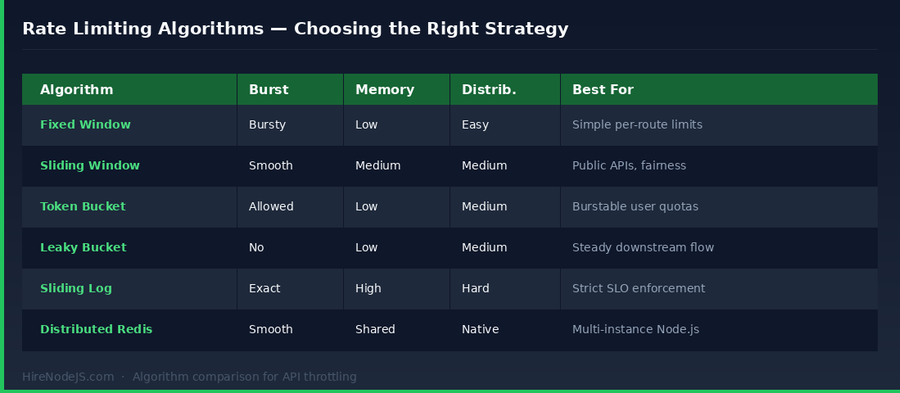
The Six Algorithms Every Node.js Engineer Should Know
Most production rate limiters are built on one of six algorithms. Choosing well saves you from rewrites later.
Fixed Window
Counts requests inside discrete time buckets — for example, 100 requests per 60-second window starting at minute 0. Cheap to implement (one Redis INCR per request) but allows up to 2x the limit at window boundaries: a client can fire 100 requests at 0:59 and another 100 at 1:00.
Sliding Window Log
Stores every request timestamp in a sorted set and counts those within the last 60 seconds. Perfectly accurate but memory cost grows linearly with traffic — fine for low-volume endpoints, brittle at scale.
Token Bucket
The default for most APIs in 2026. A bucket refills at a steady rate (e.g., 10 tokens per second) up to a max capacity (e.g., 200). Each request consumes one token; if the bucket is empty, the request is rejected or queued. Burstable, predictable, and cheap.
Node.js Libraries Worth Using in Production
Three libraries dominate the ecosystem in 2026: rate-limiter-flexible (most flexible, supports Redis, Memcached, Mongo, in-memory), express-rate-limit (the simplest middleware option), and @upstash/ratelimit (best for serverless edge runtimes).
When to use which
Pick express-rate-limit for monoliths with a single instance and simple needs. Pick rate-limiter-flexible the moment you have more than one Node.js instance or need anything beyond fixed window — pair it with Redis so all instances share state. Pick @upstash/ratelimit on Vercel, Cloudflare Workers, or AWS Lambda where you need HTTP-based limiting without persistent connections.
// Production-grade rate limiter for Express using rate-limiter-flexible + Redis
import express from 'express';
import { createClient } from 'redis';
import { RateLimiterRedis } from 'rate-limiter-flexible';

const app = express();
const redisClient = createClient({ url: process.env.REDIS_URL });
await redisClient.connect();

// Token bucket: 100 requests, 60s window, with 200 burst capacity
const limiter = new RateLimiterRedis({
  storeClient: redisClient,
  keyPrefix: 'rl:api',
  points: 100,            // sustained limit
  duration: 60,           // per 60 seconds
  blockDuration: 60,      // block for 60s after exceeding
  execEvenly: true,       // smooth out the limit
});

const rateLimitMiddleware = async (req, res, next) => {
  const key = req.user?.id || req.ip;
  try {
    const result = await limiter.consume(key);
    res.setHeader('X-RateLimit-Limit', limiter.points);
    res.setHeader('X-RateLimit-Remaining', result.remainingPoints);
    res.setHeader('X-RateLimit-Reset', new Date(Date.now() + result.msBeforeNext).toISOString());
    next();
  } catch (err) {
    res.setHeader('Retry-After', Math.ceil(err.msBeforeNext / 1000));
    res.status(429).json({
      error: 'Too Many Requests',
      retryAfter: Math.ceil(err.msBeforeNext / 1000),
    });
  }
};

app.get('/api/posts', rateLimitMiddleware, async (req, res) => {
  res.json({ ok: true });
});

app.listen(3000);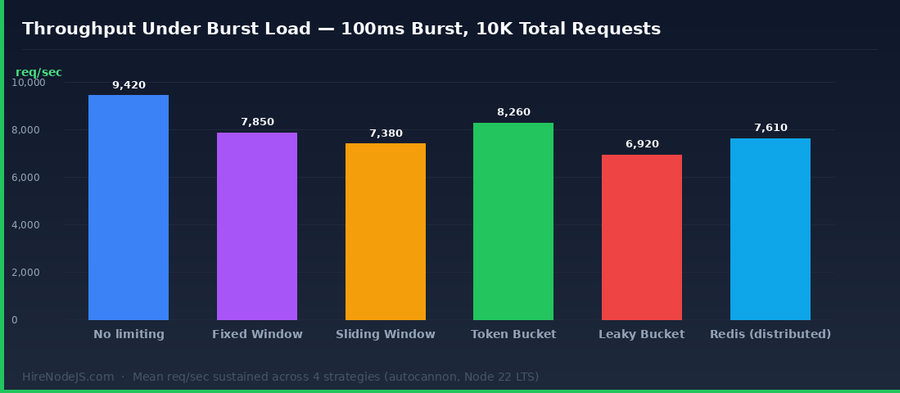
Distributed Rate Limiting Across Multiple Node.js Instances
In-memory limiters break the moment you scale horizontally. Two instances behind a load balancer with 100 req/min limits each effectively become 200 req/min — and clients can game your system by reconnecting. The fix is centralised state, almost always in Redis. For teams running Kubernetes or autoscaling fleets, this is non-negotiable.
Atomic Redis operations
The trick is making the increment-and-check operation atomic. Naive INCR + GET races at high concurrency. Use Redis Lua scripts or the dedicated commands rate-limiter-flexible compiles for you — they execute server-side and avoid round-trip races entirely.
Hire Pre-Vetted Node.js Developers
Skip the months-long search. Our exclusive talent network has senior Node.js experts ready to join your team in 48 hours.
Latency cost
A Redis hop adds ~0.5ms p50, 2ms p99 in the same VPC. For most APIs this is invisible. For ultra-low-latency endpoints (sub-1ms), pair Redis with a small in-memory cache that mirrors the last known token count and corrects asynchronously.
Designing Quotas for Multi-Tenant SaaS APIs
Public-facing SaaS APIs need tiered quotas: 100 req/min for free, 10,000 req/min for enterprise. The cleanest pattern is a hierarchy of keys — global > tenant > user > route — and the limiter consumes from each in sequence. The tightest limit wins. Teams building this from scratch often consult experienced backend engineers since the edge cases (race conditions on quota refills, partial-credit refunds on failed downstream calls) bite hard at scale.
Burst credit
Most APIs benefit from a 2x burst credit on top of the sustained limit — clients can spike for short windows without tripping limits, but cannot sustain abuse. Token bucket with a 60-second refill rate and a 120-token capacity captures this elegantly.
Charging on success only
Sophisticated APIs only count successful requests against the quota. A failed request from a downstream timeout shouldn't burn quota — refund the token in the error handler. Stripe and Twilio both do this; users feel the difference.
Monitoring and Tuning Your Rate Limiter
You can't tune what you can't see. Emit four metrics from your limiter: requests_total (by route, by tenant), requests_blocked_total, current_remaining, and time_to_reset_seconds. Plot blocked / total as a percentage — anything sustained above 1–2% is a sign your quotas are wrong, not that customers are misbehaving.
Alert on shape, not threshold
Don't alert when one tenant hits their limit — that's the system working. Alert when the blocked rate spikes 5x its baseline for any single tenant in 5 minutes. That signals either an integration bug on their side or a poorly chosen quota.
Common Pitfalls We See in Audits
After auditing dozens of Node.js codebases in 2025–2026, the same mistakes recur:
- Limiting only by IP on authenticated routes (carrier NAT problem).
- In-memory limiter on a horizontally scaled service.
- No Retry-After header — clients hammer in tight retry loops.
- Uniform global quota — should be tiered by plan, route, and method.
- Charging quota for 5xx errors caused by the platform itself.
If you're rolling out rate limiting on a production Node.js service and want experienced eyes on the architecture, HireNodeJS connects you with senior engineers who've shipped these patterns at fintech and SaaS companies — typically available within 48 hours.
Hire Expert Node.js Developers — Ready in 48 Hours
Designing the right throttling strategy is only half the battle — you need engineers who can implement it without breaking your hot paths. HireNodeJS.com specialises exclusively in Node.js talent: every developer is pre-vetted on real-world projects, API design, event-driven architecture, and production deployments.
Unlike generalist platforms, our curated pool means you speak only to engineers who live and breathe Node.js. Most clients have their first developer working within 48 hours of getting in touch. Engagements start as short-term contracts and can convert to full-time hires with zero placement fee.
Summary — A Practical Checklist
Pick token bucket as your default. Run state in Redis the moment you have more than one Node.js instance. Limit by (user, route) tuples — never IP alone for authenticated traffic. Set proper headers on every 429 response. Tier quotas by plan. Monitor blocked-percentage shape, not raw counts. Refund tokens on platform-side errors.
Done well, rate limiting becomes a quiet stabiliser of your platform — protecting your customers from each other and your infrastructure from itself. Done poorly, it becomes the first thing customers complain about. The patterns in this guide are the same ones used by APIs handling billions of requests a month in 2026.
Frequently Asked Questions
What is the best rate limiting algorithm for a Node.js API in 2026?
Token bucket is the best default for most APIs because it allows controlled bursts while maintaining a sustained limit. Pair it with Redis for distributed deployments and you cover ~90% of production use cases.
Should I use express-rate-limit or rate-limiter-flexible?
Use express-rate-limit for simple monoliths with a single instance. Use rate-limiter-flexible the moment you have multiple Node.js instances, need Redis-backed state, or want anything beyond fixed window — it scales much further.
How do I implement distributed rate limiting in Node.js?
Centralise state in Redis using rate-limiter-flexible's RateLimiterRedis or a custom Lua script. The atomic increment-and-check operation must run server-side in Redis to avoid races between Node.js instances.
What status code and headers should a rate-limited response return?
Return HTTP 429 Too Many Requests with three headers: Retry-After (seconds until allowed), X-RateLimit-Remaining (requests left), and X-RateLimit-Reset (ISO timestamp). SDK clients use these to back off intelligently.
Is it OK to rate limit by IP address?
Only for unauthenticated endpoints. For authenticated APIs, limit by user ID or API key — mobile carriers and corporate NATs route thousands of users through a single IP, and IP-only limits will block legitimate traffic.
How do I handle rate limit refunds when downstream calls fail?
In your error handler, call limiter.reward() (or the equivalent in your library) to refund the token consumed. This way platform-side failures don't burn customer quota — a small UX win that compounds.
Vivek Singh is the founder of Witarist and HireNodeJS.com — a platform connecting companies with pre-vetted Node.js developers. With years of experience scaling engineering teams, Vivek shares insights on hiring, tech talent, and building with Node.js.
Need a Node.js engineer who has shipped throttling at scale?
HireNodeJS connects you with senior backend engineers who have implemented production rate limiting for fintech, SaaS, and gaming APIs. Pre-vetted, available within 48 hours, no recruiter fees.