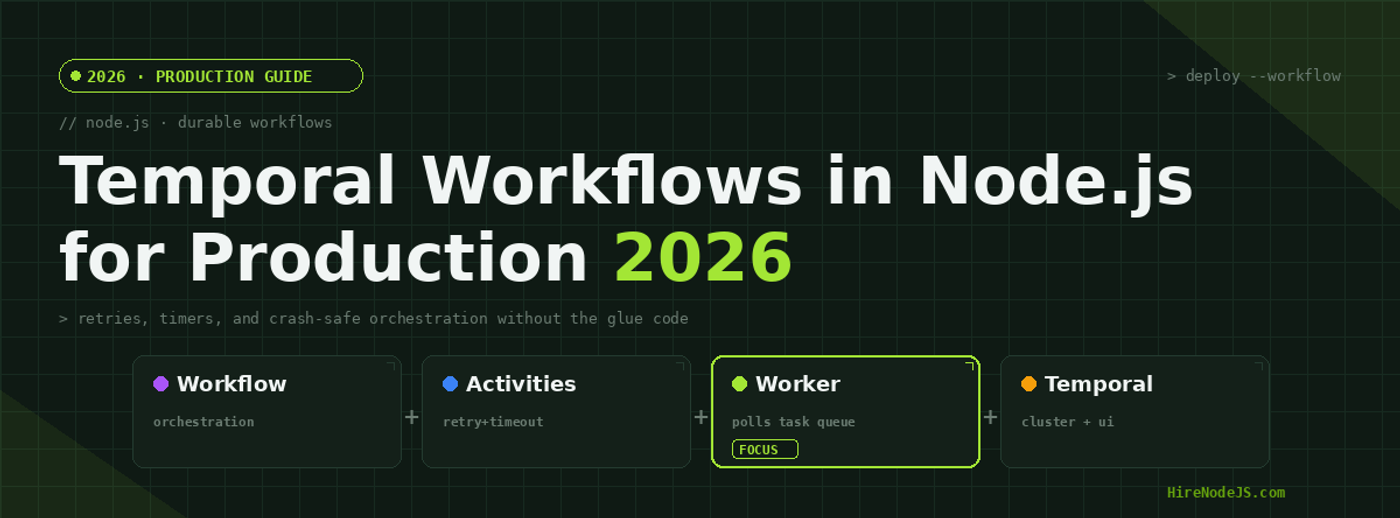
Node.js + Temporal in 2026: The Durable Workflows Guide
If you have ever shipped a Node.js service that talks to Stripe, sends emails, writes to two databases, and calls a partner API — you have probably written the same boilerplate three times: a queue, a status table, a retry loop, and a job that scans for orphaned tasks at 3 a.m. That boilerplate is a workflow engine. It is just a bad one, hidden in your codebase, with no UI and no replay.
Temporal flips that around. You write straight-line TypeScript that says "charge the card, then send the email, then mark the order paid" — and the platform makes it crash-safe, replayable, and observable for free. In 2026, Temporal has become the default answer for durable execution in Node.js, and it shows up in nearly every senior backend interview we run. This guide walks through the architecture, the SDK, the production patterns, and the failure modes you only learn the hard way.
Why Durable Workflows Matter in 2026
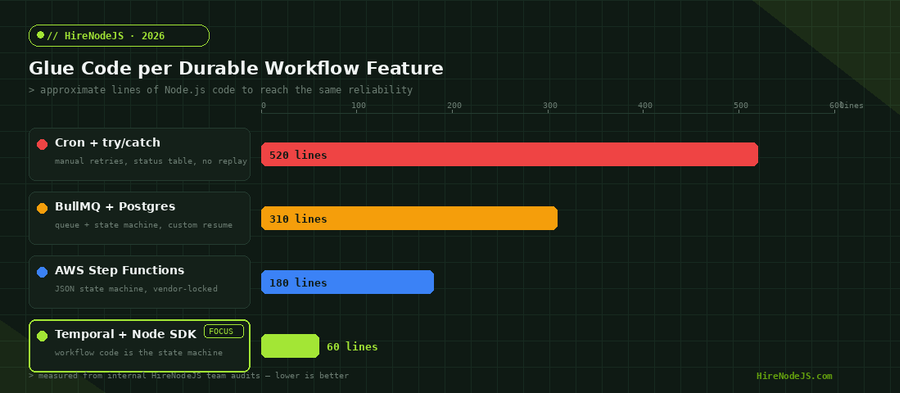
A "workflow" in production Node.js is any business process that has more than one step, takes longer than a single HTTP request, and absolutely must finish — order processing, KYC checks, multi-tenant onboarding, AI agent loops, ETL pipelines. Until recently, teams stitched these together from cron jobs, BullMQ queues, and a Postgres status table. The result was reliable in steady state and catastrophic when a worker crashed mid-run.
The hidden cost of hand-rolled orchestration
Every team that has built this from scratch eventually pays the same tax: a status column with twelve possible values, a recovery script that reads it, a deduplication table for activities that ran twice, and a Slack channel called #workflow-incidents. The code that does the actual business work is buried under infrastructure plumbing.
What Temporal Actually Gives You
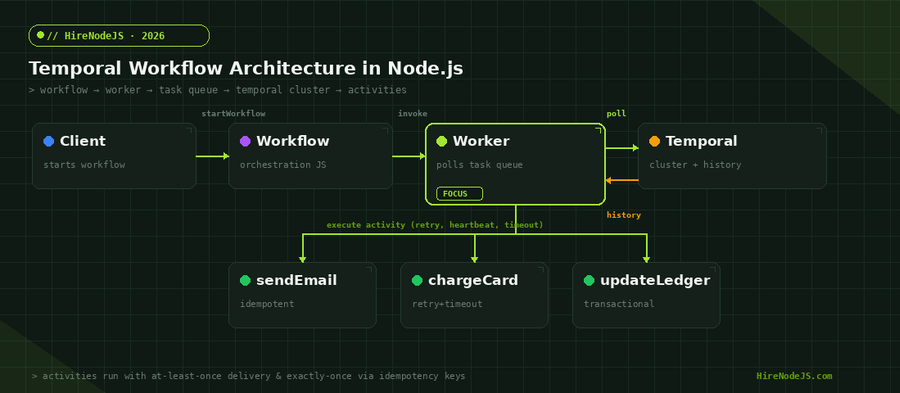
Temporal is two things at once: a server (an open-source cluster you run, or Temporal Cloud) and a Node.js SDK that runs inside your worker process. The server keeps the durable history of every workflow run; the SDK turns your workflow function into a deterministic, replayable program.
Workflows, activities, and the determinism rule
A workflow function is the orchestration: branches, awaits, retries, timers. It must be deterministic — no Date.now(), no Math.random(), no direct I/O — because the SDK will replay it from history after a crash. Anything non-deterministic gets pushed into an activity, which is just a normal async function the worker invokes through the cluster.
What you stop writing
After adopting Temporal, the same engineering team usually deletes their job table, their cron-driven recovery script, their custom retry decorators, and the dead-letter queue logic that nobody fully understood. The platform absorbs all of that, and the workflow code shrinks to the actual business logic.
Setting Up the Temporal Node.js SDK
Temporal ships a first-class TypeScript SDK that runs on Node 20 LTS and Node 22. You install three packages: the client (used by your API), the worker (runs the workflow code), and the activity bundle (your real-world side effects). Most teams put each in its own subpackage of a monorepo so the worker container ships with only what it needs.
Install and run a local cluster
For local development, the Temporal CLI ships a single-binary cluster you can run with `temporal server start-dev`. It boots in two seconds, gives you a Web UI on localhost:8233, and uses an in-memory store. For production, you either deploy the open-source server on Kubernetes (which is non-trivial) or use Temporal Cloud and connect via mTLS.
npm i @temporalio/client @temporalio/worker @temporalio/workflow @temporalio/activity
npm i -D @temporalio/testing typescript ts-node

# Local cluster (single binary, ports 7233 + 8233 UI):
brew install temporal
temporal server start-dev
Writing Your First Workflow and Activities
The mental model that helps the most: workflows are coordination, activities are I/O. Your workflow file imports activities through a typed proxy and never calls them directly — that indirection is what lets the SDK record each invocation in history and replay it deterministically after a worker restart.
A complete order-processing workflow
Below is a minimal but production-shaped example: charge a card, persist the order, send a confirmation email, and roll back the charge if anything in the downstream chain fails. Notice the absence of try/catch around every call, the absence of a job table, and the natural use of `await` in straight-line code.
// activities.ts
import Stripe from 'stripe';
const stripe = new Stripe(process.env.STRIPE_SECRET!);

export async function chargeCard(amount: number, customerId: string, idempotencyKey: string) {
  return stripe.paymentIntents.create(
    { amount, currency: 'usd', customer: customerId, confirm: true },
    { idempotencyKey }
  );
}

export async function createOrderRecord(orderId: string, paymentId: string) {
  await db.orders.insert({ id: orderId, payment_id: paymentId, status: 'paid' });
}

export async function sendConfirmation(email: string, orderId: string) {
  await mailer.send({ to: email, template: 'order-paid', vars: { orderId } });
}

export async function refund(paymentId: string) {
  return stripe.refunds.create({ payment_intent: paymentId });
}

// workflow.ts
import { proxyActivities, ApplicationFailure } from '@temporalio/workflow';
import type * as A from './activities';

const acts = proxyActivities<typeof A>({
  startToCloseTimeout: '1 minute',
  retry: { maximumAttempts: 5, initialInterval: '2s', backoffCoefficient: 2 },
});

export interface CheckoutInput {
  orderId: string; customerId: string; email: string; amount: number;
}

export async function checkoutWorkflow(input: CheckoutInput): Promise<{ paymentId: string }> {
  // workflowId == orderId, so this is a natural idempotency key.
  const payment = await acts.chargeCard(input.amount, input.customerId, input.orderId);

  try {
    await acts.createOrderRecord(input.orderId, payment.id);
    await acts.sendConfirmation(input.email, input.orderId);
    return { paymentId: payment.id };
  } catch (err) {
    // any downstream failure -> compensate by refunding the charge.
    await acts.refund(payment.id);
    throw ApplicationFailure.nonRetryable('checkout failed after charge', 'CHECKOUT_FAILED');
  }
}
Most production teams pair Temporal with a strong typed-API layer. If you are also using tRPC for type-safe APIs, the input and output types of a workflow flow naturally into your client SDK. Teams that struggle here usually have unclear ownership between the API gateway and the worker — exactly the kind of architecture senior backend developers know how to set up on day one.
Hire Pre-Vetted Node.js Developers
Skip the months-long search. Our exclusive talent network has senior Node.js experts ready to join your team in 48 hours.
Production Patterns: Retries, Timeouts, and Idempotency
Temporal does not magically make your code idempotent — it gives you the primitives so you can. The three production patterns every team adopts within the first month are typed retry policies per activity class, heartbeats for long-running activities, and a discipline around idempotency keys that flows from the workflow ID into every external call.
Retry policies: be specific
Default retries forever is a footgun. For payment activities, set maximumAttempts to 1 and rely on Stripe's idempotency key for replays. For email, allow up to 5 retries with exponential backoff. For an LLM call, set a non-retryable error type for 4xx responses so you do not spend budget on a doomed prompt.
Heartbeats for long activities
Any activity that runs longer than a minute should heartbeat. The worker reports progress to the cluster, the cluster sets the activity's heartbeat timeout, and if the worker dies the activity is rescheduled — picking up from the last reported checkpoint.
Idempotency keys, not lock tables
Pass the workflow ID as the idempotency key for every external write. Stripe, AWS, and most modern APIs support this header. If a downstream API does not, wrap it in your own activity that records the workflow ID + step name in a small Postgres table before the side effect — far simpler than a distributed lock.
Operating Temporal in Production: Observability and Cost
Temporal's Web UI is the first place every on-call engineer learns to live in. You see every workflow execution, the full event history, every activity attempt, and a stack trace at the line that is currently awaiting. For a team used to grepping logs across three services, this single pane changes the shape of incident response.
Metrics, traces, and the OpenTelemetry exporter
The SDK exports metrics in Prometheus format and traces over OpenTelemetry, so your existing Grafana / Datadog / Honeycomb stack picks them up without configuration. The two metrics you alert on day one: workflow_task_schedule_to_start_latency (your worker is overloaded if this spikes) and activity_failure_count by activity name.
Cost: cluster, storage, and worker fleet
If you self-host on Kubernetes, the cluster is three components — frontend, history, matching — plus Cassandra or Postgres for storage. A small fleet (under 10 million workflow executions per month) runs comfortably on $200-500 of compute. Temporal Cloud is significantly more, but the team you do not hire to run the cluster usually pays for it.
If you are running this on Kubernetes, the worker fleet is a stateless Deployment — scale on CPU, not request rate. The cluster itself is more involved; many teams choose Temporal Cloud specifically to avoid running stateful StatefulSets in production.
When NOT to Reach for Temporal
Temporal is a heavy hammer. If you have a single-step background job — "send this email", "resize this image" — BullMQ on Redis is faster to ship and lighter to operate. If your workflow finishes in under 200 ms and never crosses a network boundary, plain async/await is fine. The decision point is durability: do you need the run to survive a worker crash mid-flight, with the same partial state? If yes, Temporal earns its complexity. If no, do not pay for it.
Realistic alternatives to weigh
BullMQ for short jobs, Inngest if you want a managed event-driven model with less ceremony, AWS Step Functions if you are deeply on AWS and accept the JSON state machine, and Restate as a newer competitor with a similar value proposition. Temporal wins on Node.js maturity, polyglot story, and the depth of the SDK — but the answer is rarely "obvious" without working through a real workload.
Hire Expert Node.js Developers — Ready in 48 Hours
Temporal pays off when the engineers running it have shipped durable workflows before. HireNodeJS.com specialises exclusively in Node.js talent: every developer is pre-vetted on real-world projects, async patterns, event-driven architecture, and production deployments — including teams who have run Temporal at scale.
Unlike generalist platforms, our curated pool means you speak only to engineers who live and breathe Node.js. Most clients have their first developer working within 48 hours. Engagements start as short-term contracts and can convert to full-time hires with zero placement fee.
Wrapping Up
Durable execution used to be a bespoke engineering effort that took months to get right and years to make safe to operate. Temporal collapses that into a library you import and a cluster you run, with the Node.js SDK giving you first-class TypeScript ergonomics. The teams that adopt it correctly — clear workflow / activity boundaries, typed retry policies, idempotency keys flowing from the workflow ID — delete more code than they write.
If you are evaluating Temporal for a real workload in 2026, the highest-leverage move is to bring on an engineer who has done it before. That is exactly the kind of senior Node.js role HireNodeJS specialises in — see the rest of our guides on caching, observability, and microservices for the surrounding stack.
Frequently Asked Questions
What is Temporal and why is it popular for Node.js in 2026?
Temporal is a durable execution platform that turns ordinary Node.js async functions into crash-safe, replayable workflows. It removes the need for hand-rolled job tables, cron recovery scripts, and dead-letter queue logic, which is why senior Node.js teams have made it the default in 2026.
How is Temporal different from BullMQ or AWS Step Functions?
BullMQ is a job queue — great for single-step background jobs, but you build state, retries, and replay yourself. AWS Step Functions is durable but uses a JSON state machine and ties you to AWS. Temporal lets you write workflows as plain TypeScript with a polyglot SDK and full event-history replay.
Can I run Temporal in production without dedicated DevOps?
Yes — Temporal Cloud removes the operational burden and most teams under 10M workflow executions per month start there. Self-hosting on Kubernetes is possible but requires real expertise in stateful workloads; budget for at least one engineer comfortable with Cassandra or Postgres at scale.
Do Temporal workflows need to be written in TypeScript?
Workflows must run in the Node.js SDK, which is fully typed for TypeScript. Plain JavaScript works but you lose the activity-proxy type inference that catches most determinism bugs at compile time. We strongly recommend TypeScript for any Temporal project.
How long does it take to migrate from BullMQ to Temporal?
For a single-team service with under 20 workflow types, expect 2–4 weeks for a senior engineer to migrate, including replacing the status table, removing the recovery cron, and rewriting tests. The biggest cost is rethinking workflows as deterministic code, not the line count.
Where can I hire Node.js developers experienced with Temporal?
HireNodeJS connects you with pre-vetted senior Node.js engineers, including specialists in Temporal, BullMQ, and event-driven architectures. Most clients have their first developer working within 48 hours, with no recruiter fees.
Vivek Singh is the founder of Witarist and HireNodeJS.com — a platform connecting companies with pre-vetted Node.js developers. With years of experience scaling engineering teams, Vivek shares insights on hiring, tech talent, and building with Node.js.
Need a Temporal-Savvy Node.js Engineer?
HireNodeJS connects you with pre-vetted senior Node.js engineers who have shipped durable workflows in production with Temporal, BullMQ, and event-driven systems — available within 48 hours. No recruiter fees.