Node.js Testing in 2026: Jest, Vitest & Supertest Guide
Testing is the single biggest predictor of how long a Node.js codebase survives without an ugly rewrite. In 2026, the toolbox has matured dramatically: Vitest has overtaken Jest in many new projects, Node.js ships a stable native test runner, and Supertest remains the de-facto choice for HTTP integration tests. But the fundamentals — fast feedback, the right test pyramid, and trustworthy mocks — matter more than which runner you pick.
This guide walks through everything a senior Node.js engineer should be doing in 2026: choosing between Jest, Vitest, and Node's native runner; structuring unit, integration, and contract tests; using Supertest for API tests; mocking external dependencies cleanly; and wiring it all into a CI/CD pipeline that gives you signal in under five minutes.
Why Testing Matters More in 2026
Modern Node.js services are smaller, more numerous, and more interconnected than ever. A typical 2026 backend ships across 8–15 microservices, talks to AI providers, message queues, and cache layers, and is deployed dozens of times a week. Without rigorous testing, every release is a controlled experiment on production users. Companies that hire Node.js developers specifically for backend work increasingly screen for testing literacy — not for memorising APIs, but for understanding when each layer of the test pyramid earns its keep.
The cost of skipping tests
A 2025 Stack Overflow survey put the median time spent fixing regressions in untested codebases at 23% of total engineering time. Worse, regressions in event-driven systems often surface days later, in a different service, after a queue has been drained. By the time you find the bug, the engineer who wrote it has moved on.
What good looks like
A healthy 2026 Node.js codebase has: under 5 minutes of CI feedback for unit tests, sub-30-second integration suites with testcontainers, Supertest-based contract tests for every public route, and at least 70% line coverage with strict branch coverage on critical paths.
Choosing Your Test Runner: Jest vs Vitest vs Node --test
There is no single right answer, but the trade-offs are clearer in 2026 than they were in 2023.
Jest 30
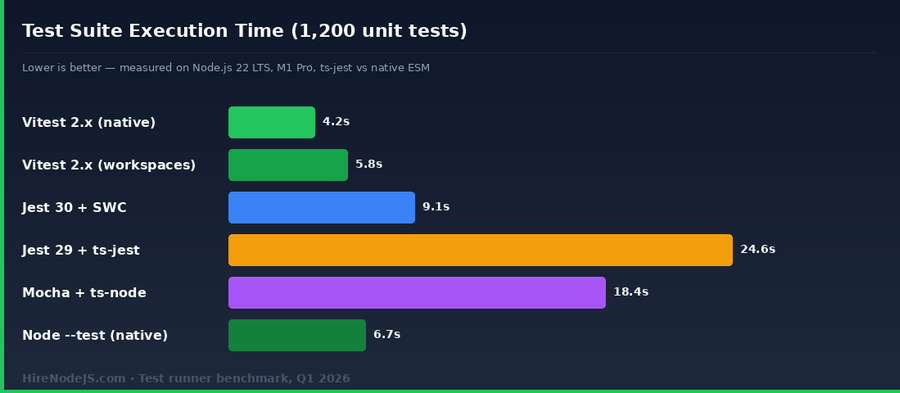
Jest is still the most-installed test runner in the Node.js ecosystem and probably the safest pick if you have an existing Jest suite. Jest 30 brings native ESM support, a faster default transformer (SWC), and improved snapshot serialisation. The mocking API — jest.mock('./db') — is still unmatched for ergonomics, especially for legacy CommonJS code. The downside is speed: even with SWC, Jest is roughly 2× slower than Vitest on cold starts.
Vitest 2
Vitest leverages Vite's Rollup pipeline, which makes it dramatically faster for projects already using Vite, esbuild, or modern ESM. It's API-compatible with most Jest tests, supports a built-in UI mode for debugging, and has first-class workspaces for monorepos. Vitest is the right choice for new projects in 2026, and a worthwhile migration for any project where test speed has become a bottleneck.
Node --test (native)
Node 22 LTS ships with a stable, zero-dependency test runner. It's fast, ESM-native, and produces TAP output that integrates with CI without extra plugins. The catch: the mocking story is rougher (you mostly use mock.method() or testdouble), and the ecosystem of matchers and reporters is thinner. Use it for libraries and small services where every dependency counts.
The Test Pyramid for Modern Node.js Services
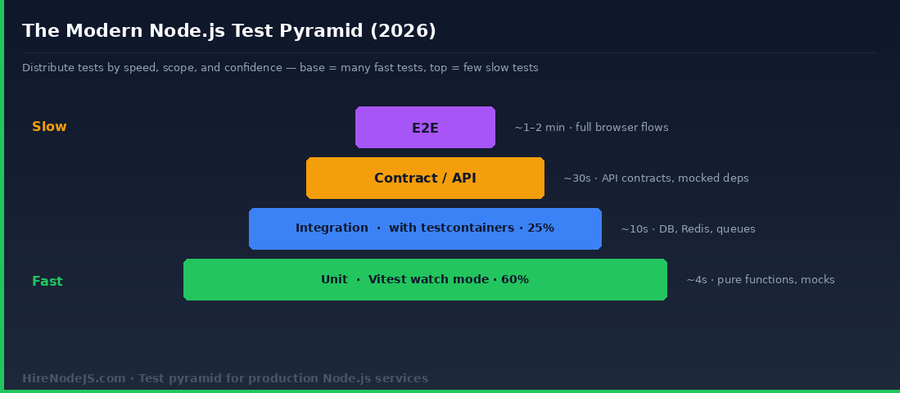
The test pyramid is older than Node itself, but it has held up remarkably well. The shape stays the same — a wide base of fast unit tests, a narrow top of slow end-to-end tests — but the proportions and tools have evolved.
Unit tests (60%)
Pure-function tests with no I/O. Run on every save in watch mode. These should never touch the database, the network, or the filesystem. If they do, they're integration tests pretending to be unit tests.
Integration tests (25%)
Tests that hit a real database, Redis, or message queue — ideally via testcontainers so each test starts from a clean state. These catch the bugs unit tests miss: serialisation errors, transaction edge cases, and ORM quirks. Teams that hire backend developers for Node.js work treat fluency with testcontainers as table stakes in 2026.
Contract & E2E (15%)
Supertest-based contract tests verify your HTTP API behaves as documented. Playwright-based E2E tests verify a critical user journey end-to-end. Both are slow, both are flaky if you're not careful — but they catch the regressions that everything else misses.
API Testing With Supertest: A Practical Pattern
Supertest is the standard for testing HTTP APIs in Node.js. It wraps any Express, Fastify, or Koa app and lets you assert against requests without binding to a real port. Combined with Vitest or Jest, it gives you fast, deterministic API contract tests.
// app/users.test.js
import request from 'supertest';
import { describe, it, expect, beforeAll, afterAll } from 'vitest';
import { createApp } from './app.js';
import { setupTestDb, teardownTestDb } from './testdb.js';

describe('POST /users', () => {
  let app;
  let db;

  beforeAll(async () => {
    db = await setupTestDb();          // testcontainers Postgres
    app = createApp({ db });
  });

  afterAll(async () => {
    await teardownTestDb(db);
  });

  it('creates a user and returns 201', async () => {
    const res = await request(app)
      .post('/users')
      .send({ email: 'ada@example.com', name: 'Ada Lovelace' })
      .set('Authorization', 'Bearer test-token')
      .expect(201);

    expect(res.body).toMatchObject({
      id: expect.any(String),
      email: 'ada@example.com',
      name: 'Ada Lovelace',
    });
  });

  it('rejects duplicate email with 409', async () => {
    await request(app).post('/users').send({ email: 'a@b.c', name: 'A' });
    const res = await request(app).post('/users').send({ email: 'a@b.c', name: 'B' });
    expect(res.status).toBe(409);
    expect(res.body.error.code).toBe('USER_EXISTS');
  });
});
Why this pattern works
Three things make this pattern robust: a real database via testcontainers (no SQLite mocks), the app factory pattern (createApp(deps)) for dependency injection, and Supertest's fluent expect() chain that fails fast with a useful diff. You never need to start a real HTTP server — Supertest binds to an ephemeral port internally and tears it down after each test.
Hire Pre-Vetted Node.js Developers
Skip the months-long search. Our exclusive talent network has senior Node.js experts ready to join your team in 48 hours.
Mocking External Dependencies the Right Way
Bad mocks are worse than no mocks. A test that passes against a mock that doesn't match production behaviour gives false confidence and rots over time. The 2026 best practice is: mock at the boundary, never in the middle.
Mock external HTTP, never your own modules
Use msw (Mock Service Worker) or nock to intercept outbound HTTP calls to third parties — Stripe, OpenAI, your auth provider. Never use jest.mock() or vi.mock() to replace your own internal modules. If you feel the urge to mock your own code, the code probably needs better dependency injection.
// __mocks__/openai.js — using msw for clean HTTP mocks
import { setupServer } from 'msw/node';
import { http, HttpResponse } from 'msw';

export const openaiServer = setupServer(
  http.post('https://api.openai.com/v1/chat/completions', () => {
    return HttpResponse.json({
      id: 'chatcmpl-test',
      choices: [{
        message: { role: 'assistant', content: 'mocked response' },
        finish_reason: 'stop',
      }],
    });
  })
);

// In your test setup file:
import { beforeAll, afterAll, afterEach } from 'vitest';
import { openaiServer } from './__mocks__/openai.js';

beforeAll(() => openaiServer.listen({ onUnhandledRequest: 'error' }));
afterAll(() => openaiServer.close());
afterEach(() => openaiServer.resetHandlers());
If you're scaling a Node.js team and need engineers who default to test-first development, HireNodeJS connects you with pre-vetted senior developers — every engineer in the pool has shipped Vitest or Jest test suites in production, knows how to wire testcontainers into CI, and can be on your team within 48 hours. No recruiter fees, no lengthy screens.
Wiring Tests Into CI/CD
Tests that don't run on every commit don't exist. The goal in 2026 is a CI pipeline that gives clear pass/fail signal in under five minutes for unit and integration tests, and under fifteen for the full E2E suite.
Parallelism is non-negotiable
Every modern CI runner supports test sharding. Split your suite by directory, by file count, or by historical timing. Vitest has built-in --shard support; Jest needs a small wrapper or the Knapsack Pro plugin.
Cache aggressively
Cache node_modules, the test runner cache (.vitest/cache or .jest-cache), and any expensive fixtures. A well-cached CI run shaves 60–90 seconds off a typical pipeline.
.github/workflows/test.yml
name: Test
on: [push, pull_request]
jobs:
  test:
    runs-on: ubuntu-latest
    strategy:
      matrix:
        shard: [1, 2, 3, 4]
    steps:
      - uses: actions/checkout@v4
      - uses: actions/setup-node@v4
        with:
          node-version: '22'
          cache: 'npm'
      - run: npm ci
      - run: npx vitest run --shard=${{ matrix.shard }}/4 --coverage
      - uses: codecov/codecov-action@v4
        with:
          files: ./coverage/coverage-final.json
Five Mistakes That Kill Test Suites
1. Sharing state between tests
Order-dependent tests are time bombs. Every test should set up its own state and tear it down. Use beforeEach (not beforeAll) for anything mutable, and randomise test order with --random or --shuffle.
2. Mocking your own database layer
A repository class mocked in unit tests will pass with bugs that only show up against a real PostgreSQL or MongoDB instance. Use testcontainers for integration tests instead.
3. Ignoring flakiness
A flaky test is a sign of either real concurrency bugs or fragile test setup. Quarantine it, dig in, and fix the root cause — never just rerun until it passes.
4. Chasing 100% coverage
Line coverage above 90% has rapidly diminishing returns. Aim for high branch coverage on critical paths (auth, billing, data writes) and accept lower coverage on boilerplate.
5. Slow integration tests with no parallelism
If your integration suite takes 10+ minutes, engineers will skip it locally and rely on CI — which means broken builds. Aim for under 60 seconds, even if it means more aggressive parallelism.
Hire Expert Node.js Developers — Ready in 48 Hours
Building a well-tested Node.js system is half engineering, half discipline — and the discipline scales with the team. HireNodeJS.com specialises exclusively in Node.js talent: every developer is pre-vetted on real-world projects, API design, event-driven architecture, and production-grade test suites with Vitest, Jest, and Supertest.
Unlike generalist platforms, our curated pool means you speak only to engineers who live and breathe Node.js. Most clients have their first developer working within 48 hours of getting in touch. Engagements start as short-term contracts and can convert to full-time hires with zero placement fee.
Conclusion: Testing as a Hiring Signal
The Node.js testing landscape in 2026 is the best it has ever been. Vitest gives you instant feedback, Jest 30 keeps the migration cost low for legacy projects, Node's native test runner removes a dependency from your toolchain, and Supertest still does the boring HTTP work nobody else wants to. Picking the right combination matters less than committing to the test pyramid and wiring it into CI.
Treat testing fluency as a primary hiring signal. An engineer who can explain when to use a contract test versus an E2E test, who reaches for testcontainers instead of SQLite mocks, and who sees flaky tests as bugs to fix rather than annoyances to retry — that's the engineer worth keeping on the team for the next five years.
Frequently Asked Questions
Should I use Jest or Vitest in 2026?
For new Node.js projects in 2026, choose Vitest — it's faster, has first-class ESM support, and works seamlessly with TypeScript. Stay on Jest 30 if you have a large existing Jest suite; the migration cost rarely beats the speed gains for stable codebases.
Is Node's built-in --test runner production-ready?
Yes. As of Node 22 LTS, the native test runner is stable, fast, and TAP-compliant. It's a great fit for libraries and small services where dependency count matters, though the mocking ecosystem is thinner than Jest or Vitest.
How much test coverage should a Node.js project aim for?
Target 70–80% line coverage with high branch coverage on critical paths (authentication, billing, data writes). Pushing past 90% has steeply diminishing returns — focus on meaningful integration tests instead of testing trivial getters.
What's the difference between Supertest and Playwright?
Supertest tests your HTTP API by binding directly to your Express or Fastify app — fast, deterministic, no browser. Playwright drives a real browser end-to-end. Use Supertest for API contract tests and Playwright for critical user journeys only.
Do I need testcontainers if I'm using SQLite for tests?
If your production database is PostgreSQL or MongoDB, yes. SQLite has different SQL dialect, transaction semantics, and concurrency behaviour — bugs that pass against SQLite routinely fail in production. testcontainers spins up a real Postgres or Mongo per test in seconds.
How long should my CI test pipeline take?
Aim for under 5 minutes for unit and integration tests, and under 15 for full E2E. Achieve this with sharding (--shard in Vitest, --shard or Knapsack in Jest), aggressive caching of node_modules and runner caches, and skipping E2E on every commit — run them only on merges to main.
Vivek Singh is the founder of Witarist and HireNodeJS.com — a platform connecting companies with pre-vetted Node.js developers. With years of experience scaling engineering teams, Vivek shares insights on hiring, tech talent, and building with Node.js.
Need Node.js engineers who default to test-first development?
HireNodeJS connects you with pre-vetted senior Node.js engineers fluent in Vitest, Jest, Supertest, and testcontainers. Available within 48 hours — no recruiter fees, no lengthy screening.